 Call Us
 18002099100



0 0 There is a particular kind of silence that falls over you the first time the sky turns green above your head. It is not something a screen can prepare you for. That unforgettable moment is what makes Northern […]
- 9 min read
Table of contents
“Where faith meets silence, every prayer finds its way.” There is a different kind of silence that settles over the moment you catch your first glimpse of the Brahmagiri hills rising behind the temple spire. It’s not the silence of an empty place, rather the silence of thousands of devotees like you who have stood in the same spot, waiting for the same darshan, carrying the same quiet hope in their chest.
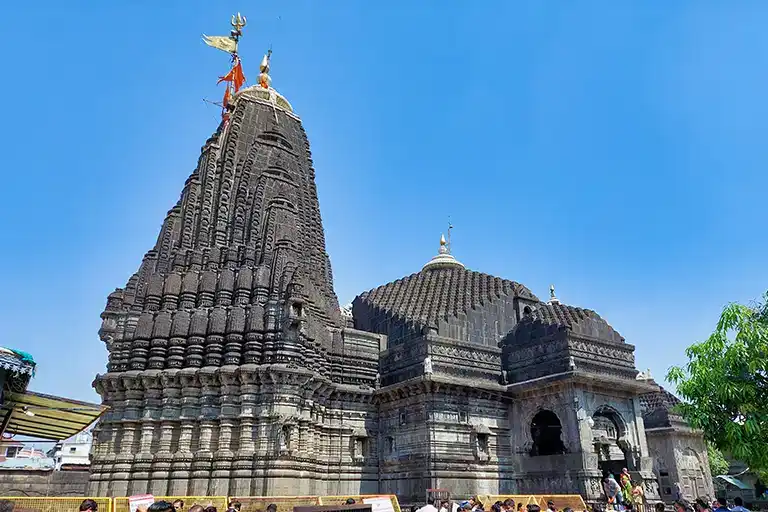
Somewhere below those hills, water is still finding its way out of the earth, the same spring that Hindus believe gave birth to the Godavari itself. A few steps ahead, behind black basalt walls carved nearly three centuries ago, sits a Jyotirlinga unlike any other in the country, one that holds three faces.
You do not need to know the full mythology to feel that you are standing in a sacred place, Trimbakeshwar Temple.
Whether you are planning a Shravan Monday visit, arranging a Kaal Sarp Puja, or simply trying to work out what a VIP darshan pass costs and how to book it, this guide walks you through the practical side of the pilgrimage: timings, rituals, routes.
Think of it as the guide you wish someone had handed you before your first visit to Trimbakeshwar.
What You Need to Know Before You Go
Trimbakeshwar Temple opens daily between 5:00 AM and 9:00 PM. Regular darshan is free, while the Donation Darshan (VIP) Pass costs around Rs. 200.
Best for: Shiva devotees, Jyotirlinga pilgrims, and anyone visiting during Shravan or the upcoming Simhastha Kumbh Mela
How much time do you need? Half a day for darshan and Kushavarta Kund, a full day if you are also booking a Rudrabhishek or exploring nearby attractions.
Best way to visit: Book the VIP pass online 2-3 days ahead, especially for Shravan Mondays and weekends
Best nearby stop: Kushavarta Kund, the believed source point of the Godavari River
Best time to visit: October to March, for cooler weather and no monsoon closures
Plan ahead for: Kaal Sarp Puja or Narayan Nagbali Puja, both need advance booking with a temple-authorised priest and take a full day.
Why is Trimbakeshwar Unique Among the 12 Jyotirlingas?
Unlike the other eleven Jyotirlingas, the Shivling at this Trimbakeshwar Shiva Temple sits low in a small stone cavity and shows three faces in one, representing Brahma, Vishnu and Mahesh together, which is why devotees also call the deity Trimbakeshwar Mahadev. Water constantly flows over it from an underground spring. Just above the temple, the Brahmagiri hills cradle the source of the Godavari, making this Trimbakeshwar Mandir both a Jyotirlinga and a river-origin site in one visit.
Quick Facts
Detail | Information |
Location | Trimbak, Nashik district, Maharashtra |
| Nearest City | Nashik (28 to 30 km) |
Temple Timings | 5:30 AM to 9:00 PM ( may change during festivals) |
| Best Time to Visit | October to March |
Entry Fee | Free for regular darshan |
| VIP Pass Cost | Approx. Rs. 200, up to Rs. 500 on peak days |
Also Known As | Trimbakeshwar Mandir, Trimbakeshwar Jyotirlinga Temple, Trimbakeshwar Jyotirling Mandir, Trimbakeshwar Shiva Temple |
Bookmark this Trimbakeshwar Jyotirlinga timings table because it’s worth re-checking closer to your travel date, since darshan slots shift slightly around festivals.
History: Sage Gautam, the Origin of the Godavari & the Legend of Trimbak
The name itself comes from this story: “Tri” for three, tied to the three-faced linga, and “Trimbak” as the older name for the town that grew around the temple, which is why you’ll also see it written as Trimbakeshwar Mandir or, in some records, Trimbakeshwar Jyotirling Mandir.
According to Hindu tradition, Sage Gautam Rishi performed intense penance here to seek Lord Shiva’s forgiveness and relief from a cow-slaying curse. Moved by his devotion, Shiva manifested as a Jyotirlinga and agreed to reside at Trimbakeshwar.
It is also believed that the holy river Godavari emerged from the Brahmagiri hills by the blessings of Lord Shiva, and hence it was called the “Ganga of the South”. The association of this rare combination of a famed Jyotirlinga and one of the holiest rivers in India makes Trimbakeshwar one of the most important pilgrimage sites in the country.
The Story Behind Trimbakeshwar’s Sacred Architecture
The Trimbakeshwar Temple Nashik was constructed in the 18th century under Peshwe Nanasaheb in black basalt stone in place of an earlier shrine. The spires are Nagara-style, the stone carving is intricate, and the inner sanctuary built around the three-faced linga took decades to complete and is still largely unchanged today. It also preserves the holy atmosphere of the temple, while it reflects the excellent craftsmanship of the Maratha period.
Darshan Timings & Types
Different sites quote different VIP figures for Trimbakeshwar Temple timings and pass costs. Some say Rs. 200, others Rs. 200 to 500. The temple trust’s own figure is Rs. 200 per person on a normal day, rising to Rs.500 during Shravan Mondays and major festivals.
Darshan Type | Timing | Cost | Notes |
| Regular | Temple opens at 5:30 AM and remains open until 9:00 PM | Free | Waiting times vary depending on crowd levels and festivals |
Donation Darshan Pass | Available through the official Trust website and designated counters | Rs. 200 | QR pass and valid ID proof required |
| Rudrabhishek | As per booking slot | Separate booking | Confirm timings directly with the temple trust |
Note: The official Donation Darshan Pass costs ₹200 per person. Additional arrangements or temporary festival-specific pricing may be announced by the temple trust during peak pilgrimage periods.
1. Regular Darshan (5-Metre Viewing Distance Rule)
Free for everyone, regular darshan runs from 5:30 AM to 9:00 PM. Devotees view the linga from roughly 5 metres away rather than up close, which is the temple’s standard arrangement to manage crowd flows through the small inner sanctum.
2. VIP or Donation Darshan Pass: Cost, Timing & How to Book Online
Visit the official Trimbakeshwar Devasthan website for Trimbakeshwar online booking, and the process is quite straightforward.
The Trimbakeshwar VIP Pass, also known as VIP Darshan, provides a more convenient darshan experience for devotees. The Pass is priced at ₹200 per person and can be booked online.
After booking, devotees can download their QR pass from the Transaction History section and need to carry it along with a valid ID proof and show it at Uttar Mahadwar for verification before entering the temple.
If you are visiting on weekends, festivals, or the Shravan month, Trimbakeshwar booking online in advance is recommended as demand for darshan passes may be higher than usual.
3. Rudrabhishek & Abhishek Timings
Morning temple rituals are generally conducted between 7:00 AM and 8:30 AM (this timing is mentioned for Puja of Brahma Deva). Specific puja timings may vary, so devotees should verify the actual schedule with the temple trust according to their booking slots and for special rituals.
Kaal Sarp Puja & Narayan Nagbali Puja at Trimbakeshwar
Trimbakeshwar is also one of the few temples authorised to perform remedial rituals like Trimbakeshwar Kaal Sarp Puja (also spelt Kalsarp Pooja Trimbakeshwar) and the Trimbakeshwar Narayan Nagbali Puja, sometimes written as Narayana Naga Bali Puja Trimbakeshwar. Both are booked separately from darshan, performed by temple-authorised priests, and typically take a full day, so build them into your itinerary rather than trying to add them on the same morning as a VIP darshan.
Dress Code & Rituals for Men and Women
For darshan itself, modest clothing is enough. For rituals like Rudrabhishek, Kaal Sarp Puja, or Narayan Nagbali, men are required to wear a plain white dhoti with an uparne (a shoulder cloth), available for hire near the temple if you don’t carry one.
Women aren’t held to a specific ritual uniform the way men are, but the same modest-dress principle applies more strictly here than at a typical darshan: a saree or salwar kameez that covers the shoulders and legs is the norm, both for general darshan and for sitting through a ritual like Rudrabhishek or Narayan Nagbali.
Leggings, shorts, sleeveless tops, and short dresses are best avoided, and leather items (belts, bags) are usually left outside before entering the sanctum.
Trimbakeshwar & the Nashik Kumbh Mela Connection
Trimbakeshwar and Nashik jointly host the Simhastha Kumbh Mela once every twelve years, beginning with a flag-hoisting ritual at the Trimbakeshwar Jyotirlinga Temple and Ramkund.
Recent Government of India and Maharashtra sources consistently refer to the upcoming event as Simhastha Kumbh Mela 2027 and have established authorities, infrastructure plans, and conservation projects specifically for Kumbh Mela 2027, and temple announcements for the latest schedules and travel advisories.
Here‘s the full Kumbh Mela Nashik guide that covers the bathing dates, key ghats, and Simhastha rituals in more depth.
Shravan 2026 at Trimbakeshwar: Monday Crown Darshan at Kushavarta Kund, Crowd Calendar
Shravan Mondays hold a different significance at Trimbakeshwar. Devotees get the chance to witness a special crown (mukut) darshan at Kushavarta Kund, usually around 4:30–5:00 PM in the evening, followed by a short procession. Since these Mondays attract large numbers of devotees, visitors are advised to arrive early and plan for additional time during their temple visit.
How to Reach Trimbakeshwar?
Here’s exactly how to reach Trimbakeshwar and how to plan the Nashik to Trimbakeshwar route, whichever city you’re starting from. .
1. From Nashik (28–30 km)
Nashik to Trimbakeshwar is the shortest and most common leg: 28–30 km by road, about 45 minutes by taxi or MSRTC bus.
2. From Mumbai / Pune / Shirdi
From Mumbai, it’s 165–180 km (4.5–5 hours) via Kasara and Igatpuri. From Pune, it’s 210–240 km (5–5.5 hours) via Sangamner. From Shirdi, it’s a shorter 115–120 km (2.5–3 hours), making it an easy add-on if you’re already covering the Shirdi circuit.
3. Nearest Airport & Railway Station
The nearest railway station is Nashik Road (28–38 km away, depending on which side of Nashik you’re headed to). The nearest airport with meaningful connectivity is Chhatrapati Shivaji Maharaj International Airport, Mumbai; Nashik’s own Ozar Airport is closer but has limited flights.
Route | Distance | Travel Time | Best Mode |
| From Nashik | 28 to 30 km | 45 minutes | Taxi or MSRTC bus |
From Mumbai | 165 to 180 km | 4.5 to 5 hours | Car/bus via Kasara to Igatpuri |
From Pune | 210 to 240 km | 5 to 5.5 hours | Car/bus via Sangamner |
| From Shirdi | 115 to 120 km | 2.5 to 3 hours | Taxi or bus |
Best Time to Visit (October to March)
October to March keeps daytime temperatures comfortable and skips both monsoon closures and peak summer heat, making it the best time to visit Trimbakeshwar.
Places to Visit in Trimbakeshwar: Top Nearby Attractions
If you’re looking for places to see in Trimbakeshwar beyond the temple itself, Kushavarta Kund, the Brahmagiri Hills trek (the Godavari’s actual source point), Anjaneri Hill, the Pandavleni Caves, and Saptashrungi Devi Temple all sit within a half-day’s reach. When you thoughtfully plan them along with the Trimbakeshwar visit, it is better to add another day into your itinerary. These sit alongside some of the top monuments in Maharashtra worth combining into a longer trip.
Where to Stay?
Trimbak town has simple dharamshalas and budget lodges near the temple gate, ideal for an early darshan. For more comfort, Nashik city, 28 km away, has a wider range of hotels and is a better base if you’re combining the temple with Nashik’s wine country or the Pandavleni Caves.
Suggested Itinerary (Trimbakeshwar + Nashik Wine Country + Saptashrungi, 1–2 Days)
A single day is enough to explore the Jyotirlinga Trimbakeshwar, Kushavarta Kund, and enjoy a short walk up Brahmagiri Hill. If you have two days, combine the same visit with Sula Vineyards and the Revered Saptashrungi Devi Temple. Hence, you can earn a varied experience combining the spirit, culture and celebrated wine heritage of the region. If you’d rather have it all planned out, check out these Nashik tour packages for a ready-made itinerary.
Pilgrim Tips & Common First-Timer Mistakes
A little preparation can make your pilgrimage more comfortable and meaningful. Avoid these mistakes, and you can successfully make the most of your visit to Trimbakeshwar Temple.
- Skipping the VIP pass and then queuing for hours on a Monday or during Shravan.
- Arriving in temple-appropriate clothes but without a plain white dhoti and uparne for a booked ritual.
- Not checking monsoon closures since the temple has shut on short notice during heavy rain warnings between June and September.
- Booking Kaal Sarp or Narayan Nagbali Puja too late. These need advance scheduling with a temple-authorised priest and can’t be added the same morning as a VIP darshan slot.
Pro tip: Book the VIP pass online 2–3 days ahead if you’re visiting on a Shravan Monday or a weekend; slots fill up fast once word gets around.
Frequently Asked Questions
1. What are Trimbakeshwar Temple darshan timings?
The temple is open from 5:00 AM to 9:00 PM daily.
2. How much does the VIP darshan pass cost at Trimbakeshwar?
Around Rs. 200 per person on normal days. The actual price may vary during festivals. Hence, it is advised to check the actual price through the official website.
3. Why does the Trimbakeshwar Temple Jyotirlinga have a three-faced Shivling?
It represents Brahma, Vishnu and Mahesh together in a single linga, unique among the twelve Jyotirlingas.
4. What is the dress code for men at Trimbakeshwar?
A plain white dhoti with an uparne is required for rituals like Rudrabhishek; regular darshan just needs modest clothing.
5. How far is Trimbakeshwar from Nashik and Mumbai?
About 28–30 km from Nashik and roughly 165–180 km from Mumbai.
6. Is Trimbakeshwar online Booking available for VIP darshan?
Online booking for VIP Darshan is available through the Trimbakeshwar trust website. After booking, devotees can download their QR pass from the Transaction History section and need to submit it at Uttar Mahadwar.
7. What is Kushavarta Kund and what significance does it hold?
Kushavarta Kund is a sacred tank 21 feet deep located 400 metres from Trimbakeshwar Temple. It marks the point where the Godavari River takes its origin and reappears in a mystical way.
8. What is the best time to visit Trimbakeshwar Temple?
October to March is the best time for cooler weather and fewer closures.
9. What is Trimbakeshwar Kaal Sarp Puja and Narayan Nagbali Puja?
Two remedial rituals performed by temple-authorised priests, booked separately from darshan and typically taking a full day each.
Conclusion
Trimbakeshwar is not a scared temple you just visit; it’s an experience that stays with you and unfolds slowly through faith, culture, and tradition. The sound of the evening aarti, the cool Brahmagiri air, the quiet crowd waiting for darshan- these are the things that remain in your heart forever. From taking blessings at one of the most sacred Jyotirlingas of India to being a witness to its rituals, every single moment here is a moment of faith and connection to Lord Shiva.
If Trimbakeshwar is part of a bigger pilgrimage plan, consider extending your journey to other revered Jyotirlingas across India. Book the best Jyotirlinga Tour Packages to have a hassle-free pilgrimage trip, or combine your visit to the nearby Bhimashankar Temple and Grishneshwar Temple to visit 3 of the sacred Jyotirlingas of Maharashtra in one trip.
Recommended Articles for you

Cherry Blossom Festival in Japan – The Ultimate Spring Escape
0 0 If there is one country that can consistently surprise you, enchant you and make you feel blessed about life, it has to be Japan. From retaining deep-rooted cultural beliefs to staying ahead in technology and being a pioneer […]

Sakura Cherry Blossom – Witness Japan’s Pink Spring
0 0 Every year, Japan’s gardens, trees and parks turn from a glorious green of jade to the soft pink of a blushing bride. That’s right, the cherry blossoms are ready to bloom, bringing with it the promise of a […]

Places to Visit in India in December
0 0 December marks the beginning of the peak travel season in India. From the North of the country to the South, every region has pleasant weather and clear skies, perfect for sightseeing. After the hot summer and muggy monsoon, […]
12 Best Places To Visit In November In India In 2026
0 0 November is a month of vibrant transitions in India, offering an array of travel experiences from the cool Himalayan foothills to the warm beaches of the south. If you’re planning your travel itinerary for November 2026, India presents […]

What is the average cost of living in Singapore in 2026?
0 0 The Cost of Living in Singapore At A Glance Average monthly budget: A single person may need S$1505 every month excluding accommodation. The rest of the budget depends on lifestyle and location. Biggest expense: Accommodation is the largest […]
Top Universities in Germany for International Students
0 0 Germany universities for international students have been one of the most preferred destinations for many years. Public universities charge little to no tuition fees, offering excellent opportunities for globally valued research and English-taught programs across engineering, business, and […]
RBI Forex Guidelines for Foreign Exchange Transactions in India
0 0 What Do RBI Forex Guidelines Say? FEMA oversees the legal mechanism governing foreign exchange transactions in India. All Indian residents should deal in forex only through RBI-authorised persons and for permitted purposes. Under the Liberalised Remittance Scheme (LRS), […]
Cost of Living Index by Country: Compare Living Expenses Around the World (2026 Guide)
0 0 No two countries charge the same price for everyday life. A coffee that costs $2 in Hanoi can cost $7 in Zurich, and a one-bedroom apartment renting for $300 in Cairo might command $3,000 in Manhattan. These gaps […]
Delhi To Haridwar distance: Best Route, Train Timings & Travel Guide
0 0 Delhi to Haridwar At A Glance Haridwar is an integral religious destination for Hindus. In 2025, 3.4 crore people visited Haridwar, and that number is only expected to be higher at the end of 2026. If you are […]
Delhi to Kedarnath distance: Best Route, Train Timings & Travel Guide
0 0 Delhi to Kedarnath cannot be called a road trip, but it is a journey where the destination is sacred, so every part of the journey becomes a kind of storytelling. Most of the people ask, “Delhi to Kedarnath […]
Jodhpur to Udaipur journey is an ultimate Rajasthan travel journey.
0 0 These two destinations have completely different personalities, but the journey between the two destinations is mesmerising. Imagine yourself waking up to the blue-painted buildings of Jodhpur, covered with mighty forts and surrounded by beautiful desert vibes. And then […]
Kullu to Manali distance: Best Route, Train Timings & Road Trip Guide
0 0 Kullu to Manali At a Glance Kullu and Manali sit in the same valley, so this isn’t really a “journey” in the way Delhi to Manali is; it’s more of a short hop most travellers do on their […]
Everything You Need to Know About Mumbai to Goa Distance
0 0 Mumbai to Goa At a Glance Goa is one of the most happening places in India. It offers nature, partying, waterfalls, trails, water activities, and whatnot. Goa sees millions of tourists every year from all across the globe, […]

Varanasi to Haridwar distance: Best Route, Train Timings & Travel Guide
0 0 Varanasi to Haridwar at a Glance Here are the numbers, before anything else. People do this route mostly for one reason: both cities run a daily Ganga aarti, and pilgrims like pairing them into one circuit. Road: roughly […]
Ride the World’s Longest Cable Car to Hon Thom Island: Your Complete Phu Quoc Travel Guide
0 0 The Hon Thom cable car in Phu Quoc is renowned for its Guinness World Record as the longest sea-crossing cable car. Offering a great view of the Gulf of Thailand, this cable car ride stretches across 7.9 km. […]
Longest Bridge in the World: Where Record-Breaking Engineering Meets Stunning Landscapes
0 0 Ask most people to name the world’s longest bridge, and you’re likely to get a confident answer like the Golden Gate Bridge or the Brooklyn Bridge or some other famous landmark plastered across postcards and movies. But the […]
World’s Largest Waterfall: Experience the Majestic Beauty of Angel Falls Like Never Before
0 0 Angel Falls in Venezuela is the highest waterfall in the world. It is 979 metres high. The falls are in a large forest area called Canaima National Park. Getting there takes time, but the views are amazing. You […]
Visit the Largest Mall in the World: Everything You Need for the Perfect Shopping Trip
0 0 Largest Mall In The World Iran Mall in Tehran, Iran, is the world’s biggest mall by total reported area. The mall is approximately 1.95 million square metres, or 21 million square feet. Note: The discussion of the biggest […]
Top 10 Highest Railway Bridges in the World: Discover the Tallest Train Bridges and Their Incredible Stories
0 0 The world’s highest railway bridges are mostly in China and India. India’s Chenab Bridge is the tallest railway arch bridge at 359 metres, which is even higher than the Eiffel Tower. China’s Najiehe Bridge, at 310 metres, still […]