Reading Time: 9 minutesQuick introduction:
- Opening dates: Between April 19 and 23, 2026. Yamunotri & Gangotri open together on Akshaya Tritiya (Apr 19), Kedarnath on Apr 22, Badrinath on Apr 23
- Registration: Free, but mandatory, and opened Mar 6 at registrationandtouristcare.uk.gov.in
- Duration: 10 to 12 days by road; 5 to 6 days by helicopter
- Budget (road): INR 20,000 to INR 80,000 per person, depending on comfort level
- Budget (helicopter): INR 1.8 lakh to INR 3.15 lakh per person
What is the Char Dham Yatra, and how does it differ from the original all-India Char Dham?
When people say “Char Dham,” they usually mean the Uttarakhand circuit. This consists of Yamunotri, Gangotri, Kedarnath, and Badrinath. But here’s the thing: the original Char Dham is actually the all-India circuit established by Adi Shankaracharya. It includes Badrinath in the North, Dwarka in the West, Puri in the East, and Rameshwaram in the South. The Uttarakhand pilgrimage is technically the Chota Char Dham, though nobody really calls it that in conversation.
For this article, we’re sticking to the Uttarakhand Chardham Yatra because that’s what you’re probably planning. If you’re planning a trip to Char Dham Yatra, this guide will help you understand the route, registration process, costs, and itinerary. The traditional sequence matters: you go clockwise, from Yamunotri to Gangotri to Kedarnath to Badrinath. There is a practical reason behind this. It helps your body acclimatise gradually before hitting the highest altitudes at Kedarnath and Badrinath.
The best time to visit
The best time to go on a Chardham Yatra is as follows:
1. May to June
The best time to go on a 4 Dham pilgrimage is between May and June. You get very favourable weather, with clear skies and pleasant temperatures. The helicopter services run at full strength during this time, as it is the peak tourist season. You will find some great Thomas Cook 4 Dham Yatra packages as well, so consider your trip in summer.
2. September to October
This is also a good time to visit the 4 Dham. It gets quite cold by October, but the pilgrimage is successful as you get clearer skies, fewer crowds, and more manageable travelling options. The helicopter services also resume at this time, and the threat of landslides and floods is reduced.
3. July to August – Not recommended
This is the monsoon season, which means landslides, road closures, and a great amount of discomfort in your 4 Dham Yatra. The helicopter services almost completely stop at this time due to dangerous weather conditions, so getting to the shrines is often a task.
Registration: Yes, It’s Mandatory. Yes, It’s Free. No, Don’t Skip It.
It is compulsory to get a Char Dham Yatra registration done. Since the 2013 Kedarnath floods, the Uttarakhand government has made registration compulsory for everyone, whether you are an Indian national or a foreigner, an infant or a senior citizen, a solo traveller or a family of twelve. It’s not a suggestion; it is something you have to get. You will not be allowed beyond the checkpoints if you don’t have your registration pass.
The Char Dham Yatra registration process opened on March 6, 2026. If you haven’t done it yet, do it today. It is free of charge.
You can do the Chardham registration for free online at registrationandtouristcare.uk.gov.in or through the Tourist Care Uttarakhand app on Android and iOS, which also offers route maps and weather updates. If you prefer not to fill forms, send “YATRA” via WhatsApp to +91-8394833833 and follow the bot prompts, or call the toll-free helpline 0135-1364 between 7 AM and 9 PM for human assistance. For last-minute planners, offline counters are available at key locations including Haridwar (Rahi Hotel), Rishikesh (ISBT, RTO, Gurudwara), Barkot, Sonprayag, and Pandukeshwar.
The Char Dham Yatra registration process
Do not get dissuaded by the Char Dham Yatra registration requirement. It is a quick and simple process. Need some help? Here you go:
- First, visit the portal, registrationandtouristcare.uk.gov.in
- Then, you must click on the new registration option
- Next, you have to enter your personal details and ID Proof (Aadhaar, PAN, etc)
- After that, upload the photo Identification document
- Once you are done, choose your travel dates and your preferred route to travel
- You then have to submit the application and obtain a Yatra Registration Letter, which bears a QR Code
- Download it and print it out, and you must have it on you at all times
Pro tip: Carry a printed copy of your Yatra Pass. Digital copies work sometimes, but checkpoint staff at Sonprayag and Pandukeshwar have been known to insist on paper. Don’t risk it.
The QR E-Pass and GPS Tracking: What It Actually Means for You
Once registered, you get a 4 Dham Yatra Registration Letter with a QR code. This gets scanned at multiple checkpoints, such as Haridwar, Rishikesh, Sonprayag, Pandukeshwar, and temple entry points. The government uses this for crowd management, daily pilgrim caps (Kedarnath limits around 12,000 people/day; Badrinath around 15,000), and for emergency tracking. If a landslide hits or the weather turns nasty, they know exactly who’s where.
Your registration also includes basic accidental insurance cover of INR 1 lakh under applicable conditions. It’s not comprehensive travel insurance, but it’s something.
The pass is date-specific and non-transferable. If you lose it, re-download from the portal using your registered mobile number.
Route Breakdown: What Each Dham Actually Demands?
1. Yamunotri
At 3,293 m, Yamunotri is a 6 km uphill trek from Janki Chatti through rocky terrain. Takes 3 to 4 hours, or a quicker pony ride. It is moderately difficult, but quite doable by most pilgrims.
2. Gangotri
Gangotri is at 3,100 m and is fully accessible by road. You drive right to the temple. This is why the Gangotri darshan is considered to be the easiest of the Char Dham.
3. Kedarnath
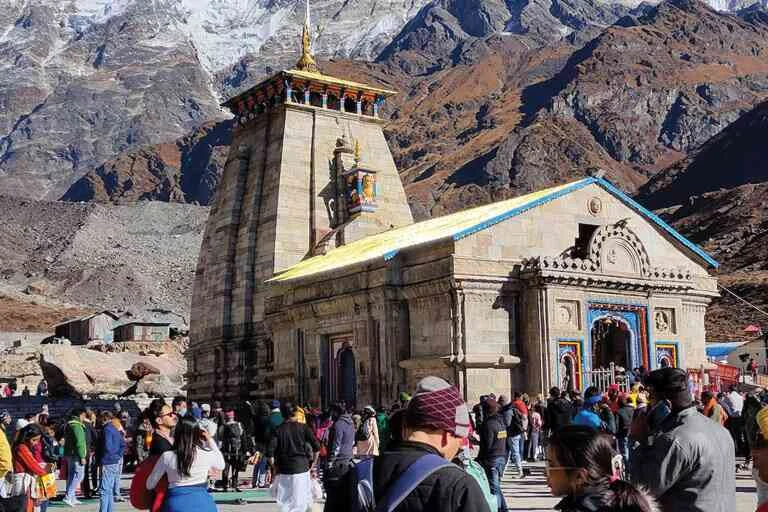
Kedarnath is the highest (3,583 m) and the hardest of the Char Dham shrines. Sixteen kilometres one-way from Gaurikund, steep and thin-aired. Ponies, palkis, and helicopters exist for a reason, and you must use them if you need to!
4. Badrinath
The Badrinath temple is 3,300 m high and has road accessibility all the way. Drive to the temple door, walk in, and offer your prayers. The temple is managed very well, making it quite organised, even when there is a great rush.
Road trip v/s Helicopter travel – A comparison.
Factor | Road Yatra | Helicopter Yatra |
| Duration | Approximately 2 weeks | Under a week |
Cost per person | Between INR 20,000 and INR 80,000 | Between INR 1.8 lakh and INR 3.15 lakh |
| Physical effort | You will have to put in significant physical effort, with treks and long drives | There is minimal physical effort with only short walks from helipads |
Scenery | You get intimate, ground-level Himalayan views | From the helicopter, you get spectacular aerial panoramas |
| Flexibility | It is highly flexible. You can stop where you want, and even change plans if required | The flexibility is quite low, as you have fixed schedules. The departures are weather-dependent, making it further rigid |
Best for | Ideal if you are a fit traveller, budget pilgrim, or just an experience seeker | It is best suited for senior citizens, time-pressed professionals, and families with small children or aged parents. |
DIY vs. Packaged Tour: Which One is Perfect for You?
1. Packaged tours
Packaged tours from trusted operators like Thomas Cook, which cost between INR 25,000–INR 70,000 for road and INR 1.8L + for helicopter, typically include transport, hotel stays, all meals, temple darshan assistance, and a tour manager who handles permits and logistics. You will also receive assistance with the Chardham registration process.
Some include VIP darshan passes that skip lines. For first-timers, families, or anyone who doesn’t want to negotiate with taxi drivers at 6 AM in Guptkashi, this is worth it.
2. DIY tours
DIY means booking your own transport (hire a taxi from Haridwar/Dehradun or use shared cabs/buses), finding hotels at each base town (Barkot, Uttarkashi, Guptkashi, Joshimath), and managing your own meals. You may save money, especially if you use GMVN (Garhwal Mandal Vikas Nigam) guest houses, which are government-run, clean, and absurdly cheap. But you’ll spend brainpower on logistics every single day. It is definitely not as convenient as a curated trip.
The verdict: If you’re under 35, travelling light, and have done Himalayan trips before, DIY is liberating. If you’re with parents, kids, or anyone who needs predictability, just book a package. The mountains are unpredictable enough, so you could do without any extra stress.
Getting There: From Your City to the Mountains
Most road trips for Char Dham start from Haridwar or Rishikesh. The Char Dham Helicopter Package often starts from Dehradun. Here’s a detailed look:
1. From Delhi
You can take an overnight train (Shatabdi, Jan Shatabdi) from Delhi. Take a bus or drive your own vehicle. The journey usually takes around 6 hours. A Char Dham yatra package from Delhi can be a convenient option for travellers planning their pilgrimage from the capital.
2. From Mumbai
If you are travelling from Mumbai, take a flight to Dehradun’s Jolly Grant Airport. From there, a quick 1-hour drive will take you to Rishikesh or Haridwar. A Char Dham Yatra package from Mumbai can simplify the journey by combining travel and pilgrimage arrangements.
3. From Ahmedabad
You can take a flight from Ahmedabad to Dehradun, or an overnight train to Haridwar. It is easy and quick to travel between the two cities.
Pro tip – From Haridwar or Rishikesh, you can hire a taxi or join a group vehicle for the circuit. The road journey is long, so expect 8 to 10 hours of driving on mountain roads. You may get carsick, so carry medication.
Suggested Itineraries: 6-Day Helicopter Trip v/s 12-Day Road Trip
Feature | 6-Day Helicopter Itinerary | 12-Day Road Itinerary |
| Travel style | Helicopter | Road and trek |
Duration | 6 days | 12 days |
| Yamunotri | Helicopter ride up to Kharsali, and then darshan | Road to Barkot, and trek from there |
Gangotri | Helicopter to Harsil, drive to Gangotri for darshan. The drive is about 25 km and takes approximately an hour. | Road to Uttarkashi, and then to Gangotri |
| Kedarnath | Helicopter shuttle to Sersi, Phata, or Guptakashi. From there, it’s a short trek to the temple for darshan | Road to Gaurikund, and from there a 14-km trek, which is challenging. You can also opt for a pony |
Badrinath | Helicopter to the helipad right next to the temple. Then, walk to the temple for darshan | Road from Joshimath + darshan |
| Trekking | Minimal trekking involved | Longer treks, challenging conditions, physical fitness required |
Buffer | 1 day included | Recommended to add 1 day |
| Best for | It is ideal for time-conscious travellers and families travelling with small children and senior citizens | This is ideal for travellers who want a slower road journey and also enjoy trekking |
Main advantage | The main advantage is that it is much faster and easier | The main advantage is that you get more time to enjoy the journey |
Crucial to Remember – Acclimatisation and Health
This isn’t a pilgrimage. Kedarnath is located at 3,583 meters, and altitude sickness can affect anyone. Be prepared so that you don’t get seriously ill. Here’s a handy guideline:
Day-by-day guidance:
- Days 1 and 2 (Yamunotri/Gangotri): Even though the altitude here is around 3,000 meters, the exertion is moderate. But remember to drink about 4 litres of water daily. Avoid alcohol entirely, as it dehydrates you and worsens altitude symptoms.
- Days 3 and 4 (approaching Kedarnath): This is where most people struggle. Sleep at Guptkashi (1,319 m) before attempting the Kedarnath trek. Don’t rush the ascent. If you experience any discomfort such as giddiness, a throbbing and sudden headache, or dizziness, descend without any delay. If you continue forward in this condition, your situation may worsen.
- Day 5 onwards (Kedarnath/Badrinath): You are at the highest altitude. Eat, breathe, and take it slow. Don’t skip meals at any cost.
Important terms to remember
1. AMS (Acute Mountain Sickness)
AMS is a common condition that strikes many pilgrims on the 4 Dham Yatra. The symptoms to watch for are:
- Headache
- Nausea
- Dizziness
- Shortness of breath
- Loss of appetite
If symptoms worsen, descend. Don’t try to push through with it. Descend to lower altitudes and seek medical help.
2. Medical fitness certificate
If you’re above 60, the government strongly recommends (and some checkpoints require) a medical fitness certificate from a registered doctor. Even if you’re younger and have heart, blood pressure, or respiratory conditions, get checked before you go.
3. Hydration advice
The mountain air is deceptively dry. You won’t feel sweaty, but you’re losing moisture constantly. Carry a water bottle and keep hydrating yourself. Electrolyte packets help.
Accommodation Options
Let’s be realistic – no one will find five-star resorts at 11,000 feet! What you can get is clean, warm, and strategically located hotels. Look for a good and safe place. Otherwise, opt for a Thomas Cook 4 Dham Yatra package and have your stay included. If you want to look at some hotel options, these are for you:
1. GMVN Guest Houses
These are your best options. Government-run, reasonably priced, and located at every base town (Barkot, Uttarkashi, Guptkashi, Joshimath). Book early, because peak season sees these fill up 3 to 4 weeks in advance.
2. Private hotels
Private hotels range from basic INR 800 per night lodges to INR 4,000+ per night “deluxe” properties with hot water and WiFi that works sometimes. At Kedarnath itself, options are limited to basic dharamshalas and tented camps.
Pro tip: May and June are the peak pilgrimage months. You have to book months in advance to even get a basic room. September to October is slightly more forgiving, but not by much. A great idea is to opt for a carefully curated Thomas Cook 4 Dham package. You simply have to book the package, and Thomas Cook will take care of all the other bookings.
Tier | Cost Range | What You Get |
| Budget | INR 22,000–INR 35,000 | This is a basic arrangement where you will get non-AC shared transport, basic hotels or dharamshalas, and simple vegetarian meals. The darshan will likely have to be self-managed as well. |
Mid-Range | INR 45,000–INR 70,000 | You can expect to have an AC private vehicle, along with stays in 3-star hotels, with all meals included. You can also get guide assistance and some VIP darshan support. |
| Premium/Road | INR 80,000–INR 1.2 lakh | If you opt for this kind of service, you will get a luxury SUV, 4-star hotel accommodation, gourmet meals, guaranteed VIP darshan, personal tour manager |
Helicopter | INR 1.8 lakh–INR 3.15 lakh | This is the quickest and most convenient type of travel for your 4-dham yatra. You get all chopper transfers and luxury hotel stays. You also get VIP darshan at all temples. Meals and ground support are included too. |
Conclusion
The Chardham Yatra isn’t a vacation; it’s a pilgrimage. That means things may go wrong, but the divine blessings you receive at the end of it all will make everything worth it. Also, the beautiful views of nature, the travels through the Himalayas, and unique experiences at every step will make this one of the most memorable trips of your life. Be smart in your planning, and book a Thomas Cook Char Dham Yatra package. You can then forget about all your worries and simply enjoy your yatra. Complete the Char Dham Yatra registration now. Book your package. Pack smart. And go with an open heart. The mountains will handle the rest.
FAQ
1. How to register for Char Dham Yatra 2026?
Online at registrationandtouristcare.uk.gov.in, via the Tourist Care Uttarakhand app, or by WhatsApping “YATRA” to +91-8394833833. It’s free and takes under 10 minutes.
2. What’s the best time to visit?
May–June for reliable weather (but crowds). September–October for thinner crowds and crisp air (but colder nights). Avoid July–August monsoons unless you enjoy landslide roulette.
3. What does a Char Dham package cost in 2026?
Road packages: INR 22,000–INR 70,000 per person, depending on comfort level. Helicopter packages: INR 1.8 lakh–INR 3.15 lakh. Peak season adds 50–100% to base prices.
 Call Us
 18002099100