 Call Us
 18002099100



Chasing the Lights Across the World’s Best Northern Lights Countries
By thomascook seo


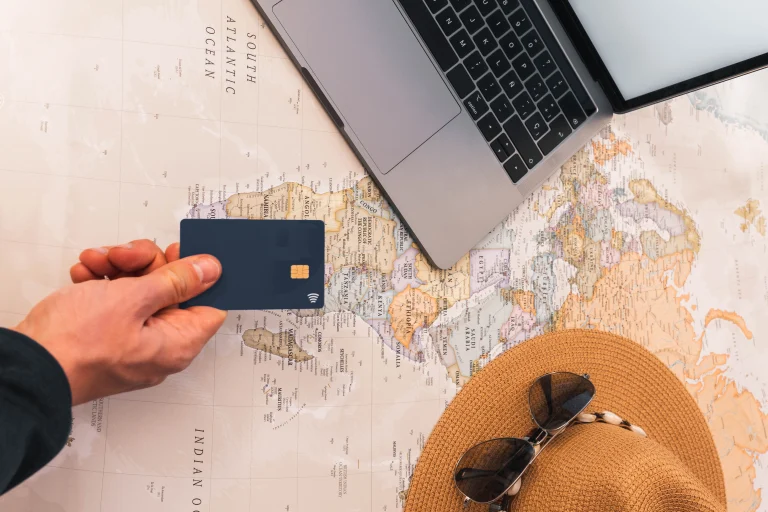
Nowadays, organising a trip abroad involves more than simply booking flights and lodging; it also involves figuring out how to pay after you arrive. Choosing the incorrect payment option can quickly damage your experience due to currency exchange rates, hidden costs, stopped transactions, and fraud threats.
For this reason, one of the most important things to do before departing is to select the best card for international travel. Your card controls how much you save—or lose—on each swipe, regardless of whether you’re a business traveller, a honeymoon pair, or a student going overseas.
We go beyond general comparisons in this blog. We will help you choose the best card for international travel by breaking down actual expenses, insider banking procedures, and smart usage tips.
The best card for international travel is not a one-size-fits-all answer. It depends on three key factors:
For example:
People frequently overlook one important factor – total cost of ownership, not simply upfront fees – when asking which card is best for international travel.
Most people are unaware of the variety of payment methods available while travelling overseas. Every kind of card has a distinct function. Before choosing the best card for international travel, it is crucial to thoroughly understand these alternatives because the correct combination can greatly lower your overall costs and increase convenience.
When it comes to predictability and cost management, forex cards are frequently regarded as the best card for international travel. Before your travel, you load foreign currency into these prepaid cards at a fixed exchange rate.
Key benefits:
● Protection against currency fluctuations
● Lower transaction charges compared to most bank cards
● Wide acceptance at international POS machines and ATMs
● Helps manage budgets effectively
Thomas Cook forex cards are perfect for students and travellers on a tight budget because they prevent overspending, unlike the best credit card for international travel.
Due to their direct connection to your bank account, debit cards are the most accessible choice. They can be used abroad, but because of their higher fees and erratic currency rates, they are rarely the best card for international travel.
Things to keep in mind:
● Foreign transaction fees can range between 2.5% and 4%
● ATM withdrawal charges are significantly higher abroad
● Currency conversion rates are determined at the time of the transaction
However, due to convenience, a lot of travellers take debit cards into account when deciding which card is best for international travel. Convenience, however, frequently has a price.
When you select the best credit card for international travel with low currency markup and travel benefits, credit cards become effective tools for travelling abroad.
Advantages include:
● Reward points, cashback, and air miles
● Complimentary airport lounge access
● Built-in travel insurance and fraud protection
● Emergency credit availability
Choosing the best credit card for international travel from India can give Indian tourists access to premium perks like concierge services, zero currency markup, and exclusive travel deals.
Credit cards, in contrast to debit cards, must be used responsibly to prevent excessive debt and high interest rates.
Knowing how each choice operates in real-world scenarios rather than merely on paper makes selecting the best card for international travel easier.
| Feature | Forex Card | Debit Card | Credit Card |
| Exchange Rate | Locked at load time | Live bank rate + markup | Network rate + markup |
| Forex Markup | 0%-1% | 2.5%-4% | 2%-3.5% |
| ATM Withdrawal | Low fixed fee | High + % fee | Very high (cash advance) |
| Spending Control | High (preloaded) | Medium | Low (credit limit) |
| Rewards | Depends on the issuer | None | Yes (points/miles) |
| Risk Level | Low | Medium | High (debt/fraud exposure) |
| Best Use Case | Planned spending | Backup cash access | Emergencies & rewards |
What most travellers don’t realise:
Because of this, seasoned travellers use all three to construct a plan for the best card for international travel rather than choose just one.
The fact that there isn’t a single winner is something that most people won’t tell you. The best card for international travel is a strategy rather than a commodity.
If you want zero stress, low cost, and maximum flexibility, use this combination:
This layered approach is what truly defines the best card for international travel.
Not all travellers should use the same setup:
So, the best card for international travel is:
Use them smartly, and you won’t just spend abroad, you’ll win financially while travelling.
Because they provide superior cost control, stable pricing, and more spending discipline than other options, Thomas Cook forex cards routinely stand out as the best card for international travel. They are designed expressly for use abroad, unlike debit or credit cards, which help travellers avoid unforeseen rate changes and hidden fees.
You can lock in currency rates with forex cards prior to your trip. For example, you save immediately if you load USD for ₹83 and the rate later increases to ₹86. They are regarded as the best card for international travel in large part because of this protection against currency fluctuations.
When you pay in Indian rupees overseas, Dynamic Currency Conversion (DCC) frequently adds an additional 5-7%. Forex cards are more economical than even the best credit card for international travel because they entirely avoid this by processing transactions in the loaded foreign currency.
You can only spend what you preload on forex cards. This automatically restricts expenditures and eliminates the possibility of post-trip debt, which is typical with credit cards, strengthening their status as the best card for international travel.
These days, a single card can support several different currencies. This is perfect for tourists visiting several nations because it guarantees smooth payments and enhances their standing as the best card for international travel globally.
Prior to selecting the best card for international travel, carefully consider these important factors:
The location of your trip will play a major role in selecting the best card for international travel. Your card approach should change to account for regional differences in acceptance rates, payment patterns, and currency stability.
This is where you really lose money, yet most people overlook it.
Small choices made when using cards overseas might have a significant financial impact. To guarantee a seamless and economical travel experience, steer clear of these typical blunders.
Small choices made when using cards overseas might have a significant financial impact. To guarantee a seamless and economical travel experience, steer clear of these typical blunders.
When travelling abroad, using a single card raises the risk. Technical faults, fraud checks, and network problems can all result in card declines. To keep access to money and prevent interruptions, always carry at least two cards, preferably the best credit card for international travel from India and a forex card.
Exchange rates are subject to frequent fluctuations, and even small variations can compound over a number of transactions. Travellers tend to underestimate its effect. During your vacation, you can save a lot of money by keeping an eye on prices or utilising a card with locked rates.
Although it may seem simple to use credit cards for every transaction, doing so may result in overspending. Even the best credit card for international travel has interest and other fees that, if not handled wisely, can raise your total bill.
Fraud notifications from overseas transactions may result in blocked cards. Notifying your bank ahead of time guarantees continuous use and prevents humiliating international payment failures.
Although debit cards are simple to use, they frequently have poor conversion rates and higher fees. Even if they are convenient, they are rarely the best card for international travel if you want to save money.
The best card for international travel is usually a Thomas Cook forex card combined with a credit card for emergencies and rewards.
Yes, forex cards offer lower fees and fixed exchange rates, while the best credit card for international travel provides rewards and flexibility.
Yes, but it involves higher charges and conversion fees, making it less ideal as the best card for international travel.
Forex cards are safest due to limited balance exposure, while the best credit cards for travel offer fraud protection features.
Forex cards typically have the lowest charges, making them the best card for international travel for cost-conscious travellers.


0 0 There is a particular kind of silence that falls over you the first time the sky turns green above your head. It is not something a screen can prepare you for. That unforgettable moment is what makes Northern […]

0 0 If there is one country that can consistently surprise you, enchant you and make you feel blessed about life, it has to be Japan. From retaining deep-rooted cultural beliefs to staying ahead in technology and being a pioneer […]
0 0 Every year, Japan’s gardens, trees and parks turn from a glorious green of jade to the soft pink of a blushing bride. That’s right, the cherry blossoms are ready to bloom, bringing with it the promise of a […]
0 0 December marks the beginning of the peak travel season in India. From the North of the country to the South, every region has pleasant weather and clear skies, perfect for sightseeing. After the hot summer and muggy monsoon, […]
0 0 November is a month of vibrant transitions in India, offering an array of travel experiences from the cool Himalayan foothills to the warm beaches of the south. If you’re planning your travel itinerary for November 2026, India presents […]

0 0 The Cost of Living in Singapore At A Glance Average monthly budget: A single person may need S$1505 every month excluding accommodation. The rest of the budget depends on lifestyle and location. Biggest expense: Accommodation is the largest […]
0 0 Germany universities for international students have been one of the most preferred destinations for many years. Public universities charge little to no tuition fees, offering excellent opportunities for globally valued research and English-taught programs across engineering, business, and […]
0 0 What Do RBI Forex Guidelines Say? FEMA oversees the legal mechanism governing foreign exchange transactions in India. All Indian residents should deal in forex only through RBI-authorised persons and for permitted purposes. Under the Liberalised Remittance Scheme (LRS), […]
0 0 No two countries charge the same price for everyday life. A coffee that costs $2 in Hanoi can cost $7 in Zurich, and a one-bedroom apartment renting for $300 in Cairo might command $3,000 in Manhattan. These gaps […]
0 0 Delhi to Haridwar At A Glance Haridwar is an integral religious destination for Hindus. In 2025, 3.4 crore people visited Haridwar, and that number is only expected to be higher at the end of 2026. If you are […]

0 0 Delhi to Kedarnath cannot be called a road trip, but it is a journey where the destination is sacred, so every part of the journey becomes a kind of storytelling. Most of the people ask, “Delhi to Kedarnath […]

0 0 These two destinations have completely different personalities, but the journey between the two destinations is mesmerising. Imagine yourself waking up to the blue-painted buildings of Jodhpur, covered with mighty forts and surrounded by beautiful desert vibes. And then […]
0 0 Kullu to Manali At a Glance Kullu and Manali sit in the same valley, so this isn’t really a “journey” in the way Delhi to Manali is; it’s more of a short hop most travellers do on their […]
0 0 Mumbai to Goa At a Glance Goa is one of the most happening places in India. It offers nature, partying, waterfalls, trails, water activities, and whatnot. Goa sees millions of tourists every year from all across the globe, […]

0 0 Varanasi to Haridwar at a Glance Here are the numbers, before anything else. People do this route mostly for one reason: both cities run a daily Ganga aarti, and pilgrims like pairing them into one circuit. Road: roughly […]
0 0 The Hon Thom cable car in Phu Quoc is renowned for its Guinness World Record as the longest sea-crossing cable car. Offering a great view of the Gulf of Thailand, this cable car ride stretches across 7.9 km. […]
0 0 Ask most people to name the world’s longest bridge, and you’re likely to get a confident answer like the Golden Gate Bridge or the Brooklyn Bridge or some other famous landmark plastered across postcards and movies. But the […]
0 0 Angel Falls in Venezuela is the highest waterfall in the world. It is 979 metres high. The falls are in a large forest area called Canaima National Park. Getting there takes time, but the views are amazing. You […]
0 0 Largest Mall In The World Iran Mall in Tehran, Iran, is the world’s biggest mall by total reported area. The mall is approximately 1.95 million square metres, or 21 million square feet. Note: The discussion of the biggest […]
0 0 The world’s highest railway bridges are mostly in China and India. India’s Chenab Bridge is the tallest railway arch bridge at 359 metres, which is even higher than the Eiffel Tower. China’s Najiehe Bridge, at 310 metres, still […]