 Call Us
 18002099100




0 0 All You Need To Know Before Planning a Cherry Blossom Trip to Japan The cherry blossom season Japan is usually from March to early May. Tokyo, Kyoto, and Osaka are popular destinations if you are visiting for the […]

8 min read
Table of contents
Agra is a city where history breathes through every stone. Home to the majestic Taj Mahal, this city in Uttar Pradesh is a treasure trove of Mughal splendor. While this iconic symbol of love often steals the spotlight, nestled nearby lies another architectural marvel waiting to be explored – the Agra Fort.
Constructed completely of red sandstone, the Agra Fort is also known as Lal Qila. Its towering walls echo tales of emperors and their regal way of life. As a UNESCO World Heritage Site, it preserves the rich history of India’s past.
In this blog, we will delve into the Agra Fort details, like the intricate carvings, courtyards, and large gates that speak volumes about Mughal craftsmanship.
Agra Fort History
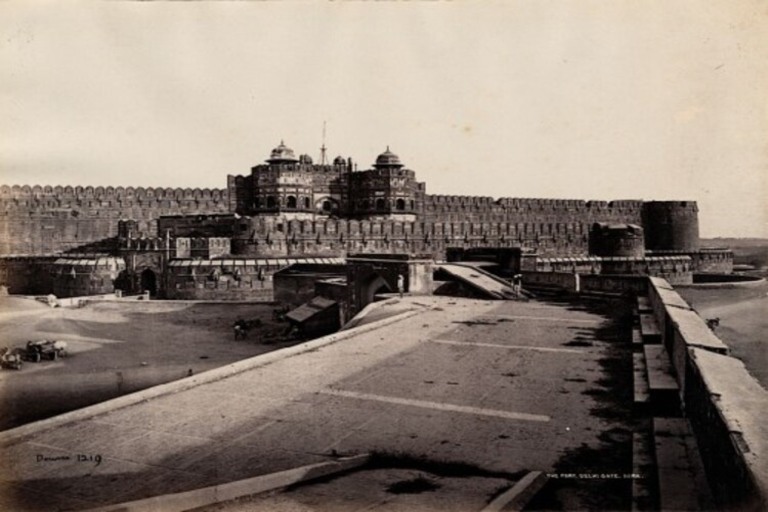
Old picture Agra Fort
Agra Fort’s history is very rich and dates back to before the 11th century, as mentioned in many ancient texts and inscriptions. Originally a brick fortress called Badalgarh under the Rajputs, it was transformed into a magnificent sandstone monument by Emperor Akbar in the 16th century. This renovation took eight years, turning the fort into a symbol of Mughal strength.
Akbar’s grandson, Shah Jahan, later demolished some structures to make room for beautiful marble buildings, which was considered a waste of revenue. When Shah Jahan was overthrown by his son Aurangzeb, he was imprisoned in the fort, where he spent his final days gazing at the Taj Mahal.
Under Aurangazeb, the fort’s structure saw few changes, except for the addition of a moat for defence. After Aurangzeb’s death, the fort changed hands multiple times until the British took over, using it for military purposes and altering some parts.
The Agra Fort architecture is a blend of Hindu and Islamic styles, with features like 70-foot tall walls, narrow walkways for defence, and secret tunnels for royal escapes. The fort’s diverse structures include Gujarati and Bengali-styled monuments, showcasing a fusion of different architectural influences.
Things to See Inside Agra Fort
The Agra Fort has various palaces and monuments constructed at different points of time through different emperors. Let’s learn about each of them in detail.
1. Amar Singh Gate
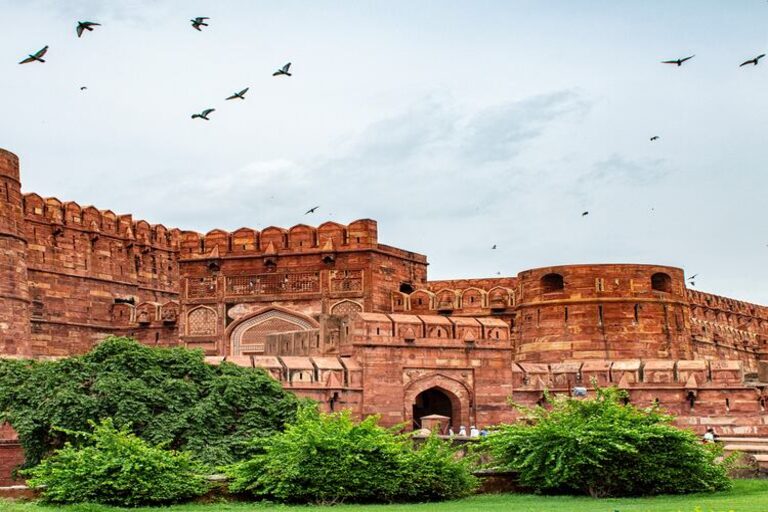
A majestic view of the Agra Fort
Amar Singh Gate is one of the four gates of Agra Fort. It is situated to the south of the complex and is the only accessible entrance to this ancient fort today. Built between 1565 and 1573, the gate was originally known as Akbar Darwaza Gate, named after the Mughal Emperor Akbar, who commissioned the construction of Agra’s Red Fort. As it faced the city of Lahore in present-day Pakistan, it was also called Lahore Gate. Later, it was renamed in honour of Amar Singh, a noble from Jodhpur known for his heroism.
As you pass through this gate, take a moment to explore the towering walls made of earthy red sandstone, standing nearly 22 metres high. The gate also has majestic octagonal watch towers flanking it, and white marble inlays decorate its facade.
Read More : Get A Glimpse Of India’s History On Weekend Getaways
2. Jahangir’s Palace
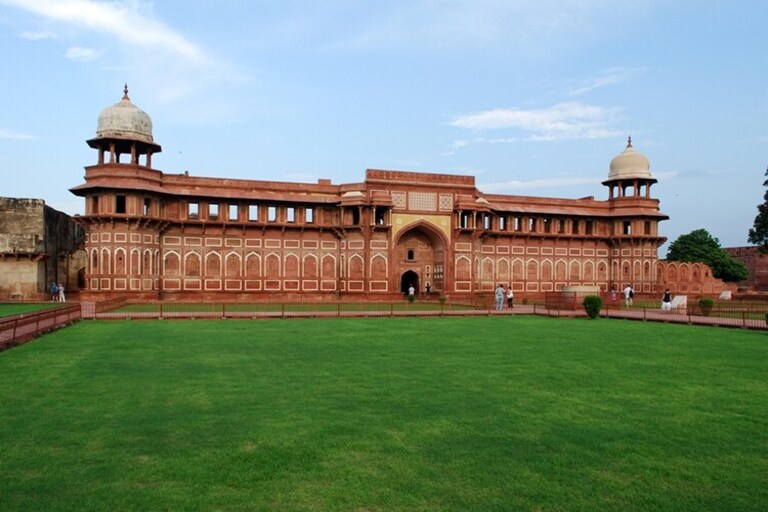
Jahangir’s Palace
Jahangir’s Palace is a crowning jewel of Agra Fort. This beautiful structure, also known as Queen Mahal, was constructed in 1570 by Emperor Akbar for his beloved son Jahangir. It served as a Zenana or women’s quarters and housed the Rajput wives of the emperor.
Surrounded by meticulously landscaped gardens, the palace boasts walls adorned with red sandstone and touches of yellow dholpur stone. Just outside the entrance, you will find Jahangir’s Hauz, a large bowl carved from a single block of stone, once used for holding fragrant rose water for bathing.
You can step through the gateway and into an inner courtyard, where stunning stone brackets and cross beams will greet you. The chambers around it feature delicate carvings, white marble trimmings, and remnants of exquisite paintings adorning every surface. It’s elegance personified.
3. Shah Jahan Mahal & Khas Mahal
Situated next to Jahangir Palace in the northwest wing of Agra Fort is the magnificent home of Emperor Shah Jahan. As the grandson of Akbar and the visionary behind the iconic Taj Mahal, Shah Jahan’s love for white marble architecture shines through in his palace.
In 1673, he transformed the once-red sandstone palace into a gleaming masterpiece, entirely clad in shimmering white marble and crowned with golden Bengal-style domes.
Two golden pavilions, almost identical, were allocated to Shah Jahan’s daughters, Jaharana and Roshnara, known as the Roshan Ara Pavilion.
Between the daughters’ residences lies Khas Mahal, Shah Jahan’s house. This opulent mansion boasts grand halls, octagonal towers, fountains, lush gardens, and ornate curtain walls, known as “sar-i-parda.”
4. Anguri Bagh
Once known as “The Garden of Grapes,” Anguri Bagh is a char bagh or quadrilateral garden with a rich history dating back to 1637. Shah Jahan built it for his wine-loving wife.
The garden’s lush landscape features dense grapevines, meticulously manicured flower beds, and hammams (bath houses) tucked away in the corners.
It was a favourite retreat for royal ladies and offered a peaceful oasis for relaxation and strolls. Today, Anguri Bagh mesmerises visitors with its 85 symmetrical gardens, a delightful fountain, and a reflective pool bordered by scalloped edges. All of these contribute to the timeless charm and allure of this historic site within Agra Fort.
5. Diwan-e-Khas
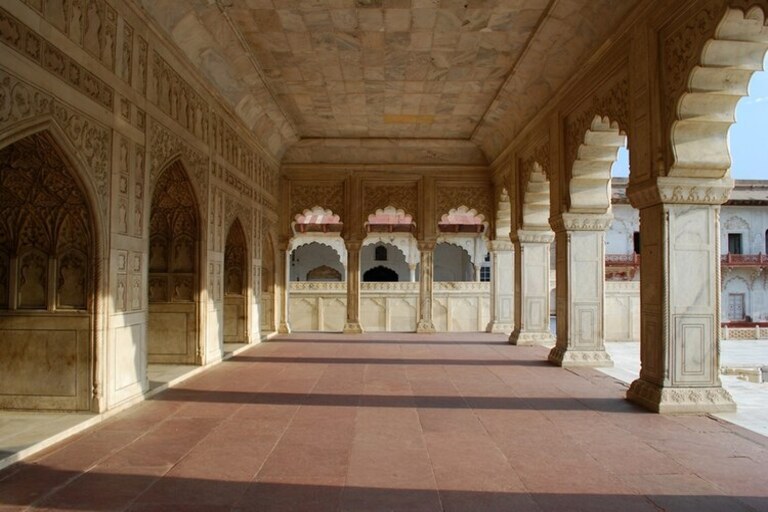
Diwan-i-Khas
Diwan-e-Khas, also known as the Hall of Private Audience, is a significant mansion within the Agra Fort complex. Constructed around 1653, this hall served as a venue for private meetings and cultural gatherings among rules, ambassadors, and nobles.
It comprises two expansive halls, an outer columned hall and an inner enclosed hall. The latter once housed the illustrious Peacock Throne, later relocated to Delhi’s Red Fort in the 18th century.
Perched overlooking the Yamuna riverside, Diwan-i-Khas mesmerizes with its distinct marble facade adorned with exquisite Persian-style floral motifs. Its interior features fine marble pillars, intricate scalloped archways, and inlays of semi-precious stonework.
6. Takht-e-Jahangir
Takht-e-Jahangir, also known as the Throne of Jahangir, is a magnificent black onyx throne imported by Emperor Jahangir from Belgium in 1602. This beautiful throne was initially housed at the Allahabad Fort before finding its place within the confines of Agra Fort in 1610.
It measures a whopping 3.2 metres in length, 2.7 metres in width, and 15 centimetres in thickness. Its top surface slopes like the shell of a tortoise and features ornate Persian inscriptions praising Jahangir as Shah and Sultan (king).
7. Sheesh Mahal
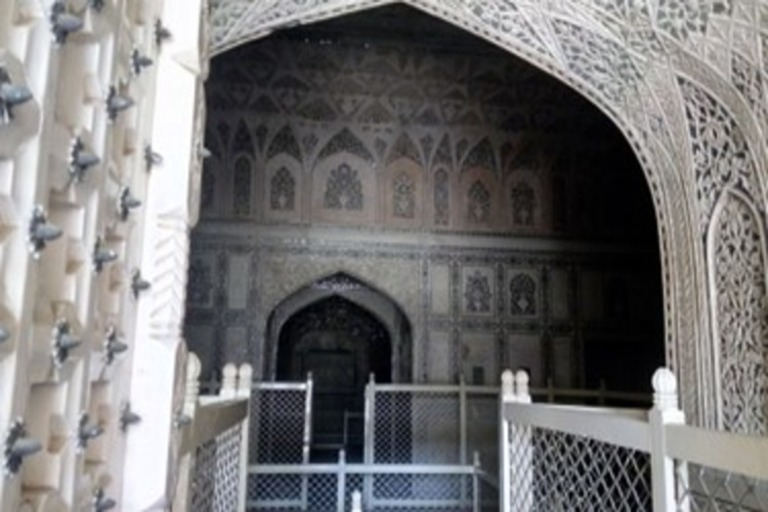
Sheesh Mahal
Prepare to be dazzled by the shimmering beauty of Sheesh Mahal, or the Mirror Palace, within Agra Fort. This exquisite palace, located in the northeast corner of the complex beneath Diwan-e-Khas, boasts walls and ceilings adorned with intricate mirror mosaics, casting a magical glow throughout the room.
Built between 1634 and 1640, Sheesh Mahal served as the imperial bath for the Queen, featuring thick walls to maintain a refreshing and cool ambience.
A true masterpiece of Indian craftsmanship, Sheesh Mahal is a testament to the extraordinary talent of its builders. While its interior is mostly closed off to visitors today, you can still catch a glimpse of its breathtaking beauty from the outside.
8. Machchi Bhawan
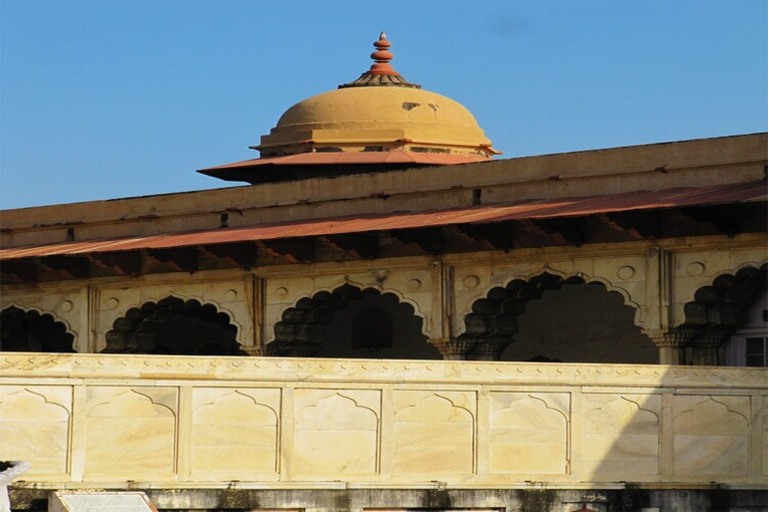
Machchi Bhawan
Machchi Bhawan, also known as Fish Palace, is a beautiful double-storied building in Agra Fort. It once featured a large pool at its centre, filled with goldfish and adorned with marble fountains. The Emperor and Empress enjoyed their leisure time by this pool, entertained by their fishy friends.
Today, the pool has been replaced with a spacious grassy courtyard and lush green gardens. On the southern side of the upper story, there is a pavilion with a stunning sun medallion carved into the ceiling. It is believed that this is where the emperor sat on his golden throne, watching over the court below.
Read More : Experience The Magic Of Golden Triangle Circuit In India
9. Diwan-i-Am
Diwan-i-Am, or the Hall of Public Audience, is a stunning pillared hall in Agra Fort where the emperor and his successors held public meetings and listened to the people’s concerns.
Built in 1628, this spacious, flat-topped building is open on three sides and features 48 intricately carved pillars topped with beautifully engraved arches. The craftsmanship here is truly remarkable!
With its exterior combining red sandstone and gorgeous white marble, Diwan-i-Am showcases Shah Jahan’s love for white marble. This elegant hall is a fine example of Mughal architecture and a testament to the artistic skills of its builders.
10. Ratan Singh Ki Haveli
Ratan Singh Ki Haveli is a fascinating part of Agra’s Red Fort, built during the 18th century when the Jat people of Bharatpur, Rajasthan, ruled the fort for 13 years. This mansion served as their residence during their reign.
This rustic red sandstone building near the Chattri of Maharaja Jawahar Singh is a sight to behold. At its centre is a large courtyard surrounded by grand arches, intricately chiselled pillars, and charming lattice windows. These architectural features add to the haveli’s allure.
Ratan Singh Ki Haveli is a testament to Jat’s architectural influence and their period of control over Agra Fort, showcasing a blend of strength and beauty in its design.
How to Visit Agra Fort
Agra Fort is situated along the Yamuna River in the northern Indian state of Uttar Pradesh, about 230 km southeast of New Delhi. The Agra Fort location is very convenient, especially since it is just 2.5 km from the famous Taj Mahal.
To reach Agra Fort from the Taj Mahal, exit through the West Gate for the shortest ride.
Auto Rickshaw/Taxi: The easiest way to reach Agra Fort from anywhere in Agra City or Agra Cantt Station is by auto rickshaw. Most rides cost between INR 50 to 70. You can also book a taxi from the roadside, through your accommodation, or using Uber or Ola apps.
Walk: If you’re near the Taj Mahal, Agra Fort is just a short 2.5 km walk away. Enjoy a leisurely stroll to the fort and soak in the sights along the way.
Best Time to Visit Agra Fort
The best time to visit Agra Fort is from October to April, when the weather is mild and pleasant. You can explore the fort from sunrise to sunset, as it is open every day from 6:00 AM to 6:00 PM.
Visiting during these months allows you to enjoy the rich Agra Fort history comfortably. So, do not miss the evening light and music show held regularly inside the fort.
Agra Fort Ticket Price
Agra Fort has four entrances, but only the southern gate, called Amar Singh Gate, is open to tourists. The Indian Army controls the North Gate, which is not open to the public. During Akbar’s reign, the southern gate was known as Akbar Darwaza because Akbar used it for his entourage.
You can find the ticket counter once you enter the fort through the southern gate.
The ticket cost varies for Indians and foreigners.
For Indians, the ticket prices are as follows:
- Cash tickets: INR 50 per person
- Cashless tickets: INR 35 per person
- Sound and light show: INR 70 per person
- Children below 15 years: Free
For foreigners, the ticket prices are as follows:
- Cash tickets: INR 650 per person
- Cashless tickets: INR 550 per person
- Sound and light show: INR 200 per person
- Children below 15 years: Free
While entering the fort, do not take the following things with you:
- Cell phone charger
- Tobacco items
- Headphones
- Merchandisable items
- Dangerous items like explosives
- Alcohol
- Knives or sharp items
Agra Fort stands as a magnificent testament to India’s rich history and architectural splendour. From the regal Amar Singh Gate to the breathtaking Sheesh Mahal, each part of this UNESCO World Heritage site tells a story of Mughal grandeur. Visiting Agra Fort offers a glimpse into the past, where emperors ruled, and artistic brilliance thrived.
For more Agra Fort information and to make the most of your visit, consider booking your trip with Thomas Cook. We offer comprehensive packages that include guided tours, comfortable accommodations, and convenient transportation options. Let us take care of all the details so you can fully immerse yourself in the wonders of Agra Fort and beyond. Plan your unforgettable journey today and explore the grandeur of India’s historic treasures.

Recommended Articles for you

Sakura Cherry Blossom in Japan
0 0 Sakura Cherry Blossom in Japan: Best Time, Places, Festivals and Travel Tips The sakura season in Japan usually starts in March in many popular destinations and continues into May in northern regions. Sakura is the Japanese word for […]

Why Is the Dollar Rising? Understanding the Factors Behind USD Strength
0 0 Why dollar price is increasing because of changes in interest rates, inflation expectations, economic growth, capital flows, and demand for the US dollar. Overall, this change is closely linked to the difference between US interest rates and those […]

Why Study in Australia? Here’s What Indian Students Should Know
0 0 Australia is a popular destination for students who want to study internationally. The opportunity to study in Australia gives access to internationally recognised qualifications, modern campuses and an environment with many cultures, helping you grow. What to keep […]

Chasing the Lights Across the World’s Best Northern Lights Countries
1 0 There is a particular kind of silence that falls over you the first time the sky turns green above your head. It is not something a screen can prepare you for. That unforgettable moment is what makes Northern […]

Places to Visit in India in December
0 0 December marks the beginning of the peak travel season in India. From the North of the country to the South, every region has pleasant weather and clear skies, perfect for sightseeing. After the hot summer and muggy monsoon, […]
12 Best Places To Visit In November In India In 2026
0 0 November is a month of vibrant transitions in India, offering an array of travel experiences from the cool Himalayan foothills to the warm beaches of the south. If you’re planning your travel itinerary for November 2026, India presents […]

What is the average cost of living in Singapore in 2026?
0 0 The Cost of Living in Singapore At A Glance Average monthly budget: A single person may need S$1505 every month excluding accommodation. The rest of the budget depends on lifestyle and location. Biggest expense: Accommodation is the largest […]
Top Universities in Germany for International Students
0 0 Germany universities for international students have been one of the most preferred destinations for many years. Public universities charge little to no tuition fees, offering excellent opportunities for globally valued research and English-taught programs across engineering, business, and […]
RBI Forex Guidelines for Foreign Exchange Transactions in India
0 0 What Do RBI Forex Guidelines Say? FEMA oversees the legal mechanism governing foreign exchange transactions in India. All Indian residents should deal in forex only through RBI-authorised persons and for permitted purposes. Under the Liberalised Remittance Scheme (LRS), […]
Cost of Living Index by Country: Compare Living Expenses Around the World (2026 Guide)
0 0 No two countries charge the same price for everyday life. A coffee that costs $2 in Hanoi can cost $7 in Zurich, and a one-bedroom apartment renting for $300 in Cairo might command $3,000 in Manhattan. These gaps […]
Delhi To Haridwar distance: Best Route, Train Timings & Travel Guide
0 0 Delhi to Haridwar At A Glance Haridwar is an integral religious destination for Hindus. In 2025, 3.4 crore people visited Haridwar, and that number is only expected to be higher at the end of 2026. If you are […]
Delhi to Kedarnath distance: Best Route, Train Timings & Travel Guide
0 0 Delhi to Kedarnath cannot be called a road trip, but it is a journey where the destination is sacred, so every part of the journey becomes a kind of storytelling. Most of the people ask, “Delhi to Kedarnath […]
Jodhpur to Udaipur journey is an ultimate Rajasthan travel journey.
0 0 These two destinations have completely different personalities, but the journey between the two destinations is mesmerising. Imagine yourself waking up to the blue-painted buildings of Jodhpur, covered with mighty forts and surrounded by beautiful desert vibes. And then […]
Kullu to Manali distance: Best Route, Train Timings & Road Trip Guide
0 0 Kullu to Manali At a Glance Kullu and Manali sit in the same valley, so this isn’t really a “journey” in the way Delhi to Manali is; it’s more of a short hop most travellers do on their […]
Everything You Need to Know About Mumbai to Goa Distance
0 0 Mumbai to Goa At a Glance Goa is one of the most happening places in India. It offers nature, partying, waterfalls, trails, water activities, and whatnot. Goa sees millions of tourists every year from all across the globe, […]

Varanasi to Haridwar distance: Best Route, Train Timings & Travel Guide
0 0 Varanasi to Haridwar at a Glance Here are the numbers, before anything else. People do this route mostly for one reason: both cities run a daily Ganga aarti, and pilgrims like pairing them into one circuit. Road: roughly […]
Ride the World’s Longest Cable Car to Hon Thom Island: Your Complete Phu Quoc Travel Guide
0 0 The Hon Thom cable car in Phu Quoc is renowned for its Guinness World Record as the longest sea-crossing cable car. Offering a great view of the Gulf of Thailand, this cable car ride stretches across 7.9 km. […]
Longest Bridge in the World: Where Record-Breaking Engineering Meets Stunning Landscapes
0 0 Ask most people to name the world’s longest bridge, and you’re likely to get a confident answer like the Golden Gate Bridge or the Brooklyn Bridge or some other famous landmark plastered across postcards and movies. But the […]
World’s Largest Waterfall: Experience the Majestic Beauty of Angel Falls Like Never Before
0 0 Angel Falls in Venezuela is the highest waterfall in the world. It is 979 metres high. The falls are in a large forest area called Canaima National Park. Getting there takes time, but the views are amazing. You […]