 Call Us
 18002099100



0 0 Planning your international Dubai Packages? Here are the must see places in Dubai. Must Do Things in Dubai 1. Ride through the sunset on an at the picturesque Dubai creek, and all for just one dirham. Close your eyes […]
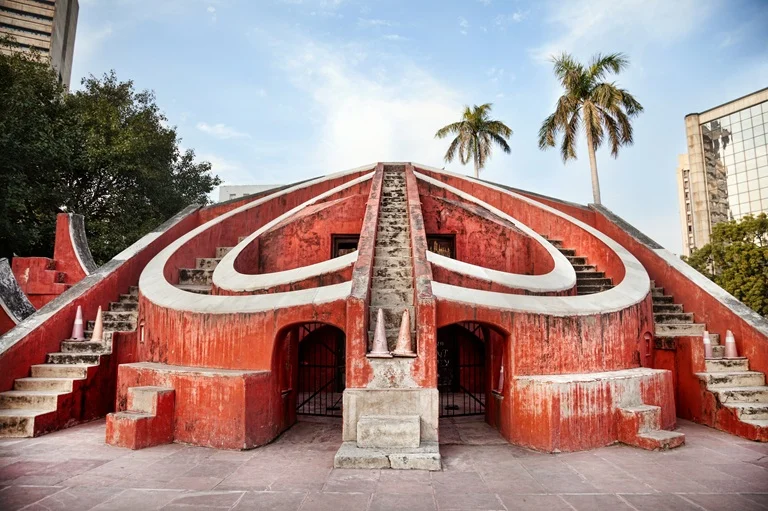
Table of contents
TL;DR: Astronomically speaking, Time’s Ticking!!! Here’s the quick version:
- What is Jantar Mantar Delhi? It is an 18th-century stone observatory near Connaught Place, built by Maharaja Jai Singh II in 1724.
- The nearest metro is Patel Chowk (Yellow Line), roughly 650 metres away, an 8-10-minute walk.
- Entry costs 30 rupees for Indians and 500 rupees for foreign nationals, and it opens daily from 6 AM to 6 PM.
- The best time to visit Jantar Mantar Delhi is early morning or just before closing, for softer light and thinner crowds.
- Pair it with Connaught Place, India Gate and the National Museum to make it into a full day out.
Overview of the Jantar Mantar Delhi
You’ll probably walk past Jantar Mantar Delhi without meaning to, if you’re anywhere near Connaught Place. That’s exactly what happens to most people the first time.
You might be hunting for a bookshop on Janpath and end up staring at a giant yellow staircase that goes nowhere, wondering “what on earth have I stumbled into?”
It’s one of those places that looks almost abstract in photos, like modern art, until you realise it’s nearly 300 years old and was built to track the stars with your bare eyes. There’s no grand entrance fanfare, no crowds pushing past you the way they do at the Red Fort. Just quiet stone structures, a patch of green, and a strange sense that you’ve slipped sideways into a different century for half an hour. This guide covers everything you’ll actually need: the fees, the timings, how to reach Jantar Mantar Delhi without getting fleeced by an auto driver, and foods to eat in Jantar Mantar.
Jantar Mantar In Delhi
At a glance:
| Information | Details |
| Built | 1724 |
| Built By | Maharaja Sawai Jai Singh II |
| Timings | 6 AM – 6 PM |
| Entry Fee | ₹30 (Indian), ₹500 (Foreign Nationals) |
| Nearest Metro | Patel Chowk |
| Time Required | 45–60 minutes |
| UNESCO Status | Part of Jaipur Jantar Mantar’s scientific legacy (avoid saying Delhi is UNESCO if not applicable) |
What is the History of Jantar Mantar Delhi?
The History of Jantar Mantar Delhi begins with a king who was more scientist than warrior.

Jantar Mantar observatory complex at sunset in New Delhi, India
Why was Jantar Mantar built?
Maharaja Sawai Jai Singh II of Jaipur built this observatory in 1724, commissioned partly by Emperor Muhammad Shah to correct existing astronomical tables that were, by most accounts, wildly inaccurate.
Jai Singh wasn’t satisfied with the telescopes of his day either, so he built something bigger instead, instruments made of stone and mortar, scaled up so far that human error in reading them became almost negligible.
That’s the bit most people miss: the size isn’t for show. Bigger instruments meant finer, more reliable readings.
The Five Observatories:
Delhi’s Jantar Mantar was actually the first of five such observatories Jai Singh built across India, with the others in Jaipur, Ujjain, Varanasi and Mathura. Only three remain fully functional today. Delhi’s is smaller than Jaipur’s but arguably more atmospheric, tucked into a city block rather than sprawled across palace grounds.
Over the centuries, some of the original instruments were damaged or lost, and a few were restored during British rule, not always accurately, which annoys astronomy purists to this day.
How did the Observatory work back in the day?
What’s easy to forget when you’re reading about the history of Jantar Mantar Delhi on a plaque is that this place actually worked.
Astronomers used it to track eclipses, measure the position of stars, calculate the time of day to within a couple of seconds, and prepare almanacks that farmers and priests relied on. It wasn’t a folly or a royal vanity project sitting idle.
People climbed these staircases with instruments and notebooks, doing real observational work, for decades. The UNESCO tag came much later, once the world caught up to what Jai Singh had already worked out with sandstone and marble.
What is the Best Time to Visit Jantar Mantar Delhi?
Picking the best time to visit Jantar Mantar Delhi comes down to two things: weather and light.
- October through March is when Delhi is at its most bearable: cool mornings, clear skies, none of that thick summer haze that turns every photo slightly grey. Aim for a weekday in December or January if you can.
- Within a single day, get there right at opening, 6 AM, or between 9 and 11 when the coach tours haven’t arrived yet.
- The golden light around 8 AM hits the Samrat Yantra’s curved walls beautifully; honestly, the best photo you’ll get all trip.
- Late afternoon, around 4 to 5 PM, works too- softer shadows, cooler breeze.
- Summer, April through June, is rough. There’s almost no shade past the entrance, and the stone genuinely radiates heat by midday.
- Monsoon brings dramatic clouds and decent light after a shower, but the steps on some instruments are slippery, so tread carefully in July or August.
Quick Tip:
Winter mornings offer the clearest skies and the best lighting for photography.
How to Reach Jantar Mantar Delhi?
Working out how to reach Jantar Mantar Delhi is easy once you know Connaught Place is the anchor point. Almost every route funnels through there.
- By car: Parking right outside the complex is limited and fills up fast on weekends. Most people drive in and park near Palika Bazaar or the outer circle and walk the rest, which honestly answers how to reach Jantar Mantar Delhi without a car better than the car option itself.
- By metro: You can easily access it through 3 different metro stations. Now which one to choose? That depends on how much walk you wanna put into your day.
| Metro Station | Distance | Best For | Metro Line |
| Patel Chowk | 650 m | Fastest walk | Yellow Line |
| Rajiv Chowk | 900 m | Connaught Place | Blue and Yellow Line |
| Janpath | 800 m | Janpath Market | Violet Line |
- By auto or cab: Autos from Connaught Place should cost 40-60 rupees on the meter, though drivers often quote 100 rupees flat to tourists outside a metro exit. Ask for the meter, or use Uber and Ola, which run reliably here.
What are the Top Attractions Near Jantar Mantar Delhi?
Once you’re done here, the top attractions near Jantar Mantar Delhi are close enough to string together on foot or with a couple of short auto hops.
- Connaught Place is literally next door, a five-minute walk. Circular colonnades, decades-old restaurants, bookshops, and enough coffee chains to keep you caffeinated for the rest of the day. Come back here for dinner even if you skip it now.
- National Museum is roughly 2 km off, on Janpath itself, and worth a couple of hours if you care about miniature paintings, old manuscripts, or Indus Valley artefacts. Skip it if you’re pressed for time; honestly, it deserves a slower visit than most top attractions near Jantar Mantar Delhi allow.
- India Gate sits about 3 km away, a ten-minute cab ride. Go in the evening when the lawns fill up with families, and the monument is lit against the dark sky; it’s a completely different mood from the daytime crowd.
- Gurdwara Bangla Sahib is a short auto ride away and free to enter. The white marble and the golden dome are striking, and the community kitchen serving free meals to anyone who walks in is worth witnessing at least once in your life.
- Parliament House and the government buildings along Sansad Marg aren’t open to casual visitors, but the walk past them, especially near sunset, gives you a sense of Lutyens’ Delhi that photographs don’t quite capture.
- Agrasen ki Baoli, a stepwell tucked behind office buildings near Connaught Place, surprises most people who’ve never heard of it. It’s free, atmospheric, and takes fifteen minutes to explore properly.
Nearly everything on this list sits within a fifteen-minute radius of Jantar Mantar Delhi, so you can string together three or four stops without ever needing more than an auto ride between them.
Where to stay near Jantar Mantar?
If you’re wondering where to stay in Jantar Mantar, the honest answer is that nobody really stays in Jantar Mantar itself; it’s a monument surrounded by government offices, not a hotel district. What people mean is staying nearby, and Connaught Place is your best base.
- Budget: Budget travellers do well with hostels and guesthouses clustered around Paharganj. A 15-20 minute auto ride away, beds run 500 to 1,200 rupees a night.
- Mid Range: Mid-range options sit right around Connaught Place, business hotels and serviced apartments in the 4,000-8,000 rupees bracket, within walking distance of the observatory and a decent spread of restaurants.
- Luxury: When you are asking yourself “where to stay in Jantar Mantar”, and planning for a splurge, the luxury hotels along nearby Sansad Marg and Barakhamba Road deliver colonial-era grandeur or slick modern comfort, depending on which one you pick, generally upwards of 12,000 rupees a night.
Whichever bracket you land in, staying central here means you can walk to Jantar Mantar Delhi before breakfast if you’re an early riser, which is genuinely one of the nicer ways to see it.
What Food to Eat near Jantar Mantar?
Foods to Eat in Jantar Mantar mostly means what’s within a short walk in Connaught Place, since the monument itself has no food stalls inside the gates.
- United Coffee House, an old Connaught Place institution, does a proper sit-down breakfast if you fancy something unhurried before or after your visit.
- For something quicker, try the Bengali Market stalls a short cab ride away: chaat, golgappas, kulfi that locals swear by more than any mall food court.
- Wenger’s, in Connaught Place’s inner circle, has been selling patties and pastries since 1926, worth the short detour if you’re walking back from Jantar Mantar Delhi peckish.
- If you fancy a proper meal, Saravana Bhavan nearby does reliable South Indian thalis and dosas that hit the spot after a morning of walking on stone in the heat.
For Foods to Eat in Jantar Mantar visits that stretch into evening:
- Karim’s is a bit of a trek towards Jama Masjid but worth mentioning if you’re doing Old Delhi the same day, mutton curry and rumali roti that people travel across the city for.
Delhi One-Day Itinerary Covering Jantar Mantar
Here’s a Delhi One-Day itinerary covering Jantar Mantar that actually works on foot and by metro, without you sprinting between sites.
- 7:30 AM: Start at Jantar Mantar Delhi right at opening. The light’s good, the crowds haven’t arrived, and you’ll have the Samrat Yantra practically to yourself for photos.
- 9:00 AM: Walk to Connaught Place for breakfast. United Coffee House or one of the smaller cafés in the inner circle both work.
- 10:30 AM: Head to the National Museum on Janpath, a short walk or five-minute auto ride. Give it 90 minutes if you’re not a museum person, longer if you are.
- 12:30 PM: Lunch near Connaught Place, Saravana Bhavan or one of the dhabas tucked into the outer circle.
- 2:00 PM: Take an auto or metro over to Gurdwara Bangla Sahib, about twenty minutes away. Cover your head, walk barefoot, and don’t skip the community kitchen. It’s a once-in-a-lifetime experience.
- 3:30 PM: Duck into Agrasen ki Baoli on your way back towards Connaught Place; it’s quick but memorable.
- 5:00 PM: Rest, or shop around Connaught Place if you’ve still got energy. This is also a decent slot for a second wander through Jantar Mantar Delhi, since the late afternoon light suits photography just as well as the morning does.
- 7:00 PM: Head to India Gate for the evening. It’s a different atmosphere entirely once it’s lit up.
- 8:30 PM: Dinner back in Connaught Place, or push on to Karim’s if Old Delhi food is on your list. That walk won’t go to waste.
This Delhi one-day itinerary covering Jantar Mantar keeps everything within a fairly tight radius, so you’re not losing hours to traffic.
Jantar Mantar Delhi vs Jaipur Jantar Mantar:
The comparison between Jantar Mantar Delhi vs Jaipur Jantar Mantar comes up constantly, since Jai Singh built both, and most travellers doing Rajasthan and Delhi on the same trip want to know if they need both stops.
- Jaipur: Jaipur’s is bigger, properly bigger, the largest of the five observatories Jai Singh built, and it sits within the Jaipur City Palace complex. It is better maintained and more actively used for astronomical demonstrations even today.
It also gets significantly more footfall, tour buses, school groups, the works, so you’re rarely alone with the instruments.
- Delhi: Delhi’s site is smaller and quieter, a patch of green wedged between government buildings rather than a palace campus. Some instruments here were damaged over the centuries and never fully restored, so you’ll notice a rawer, slightly weathered feel compared to Jaipur’s more polished presentation.
If you can only manage one after the comparison of Jantar Mantar Delhi vs Jaipur Jantar Mantar:
- Jaipur wins on scale and completeness; it’s the fuller, more impressive version of what Jai Singh was trying to build.
- But if you’re already in Delhi and have a spare hour, there’s no real reason to skip the smaller one. It’s free of the crowds, cheap to enter, and gives you the same core idea: giant stone instruments reading the sky, without needing a separate trip to Rajasthan.
Scientific Instruments at Jantar Mantar Explained
Thirteen instruments survive at Jantar Mantar Delhi, though only a handful get most of the attention. Here’s what they actually do:
- Samrat Yantra: The giant yellow staircase-like structure you’ll see in every photo is the largest sundial here. Its triangular gnomon rises 27 metres at an angle matched precisely to Delhi’s latitude. It can tell the time to within two seconds, which is remarkable for something built without a single electronic component.
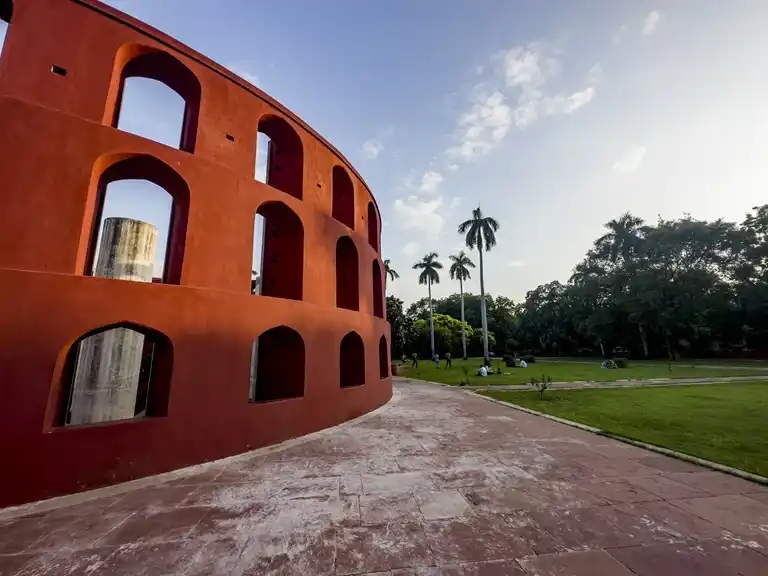
- Ram Yantra: Ram Yantra is a pair of cylindrical structures, open to the sky, used for measuring the altitude and azimuth of celestial objects. You can actually climb the internal staircases on some sections, though the guards keep a close eye on which parts are structurally sound enough for foot traffic.
- Jai Prakash Yantra: Jai Prakash Yantra consists of two concave hemispherical bowls set into the ground, marked with a grid of lines.
Astronomers would track the shadow of a small metal plate suspended above the bowl, essentially plotting the sky’s coordinates onto the ground itself. It’s one of the cleverer pieces of engineering on site, and most visitors walk straight past it without realising what they’re looking at.
- Rashivalayas: Rashivalayas, a set of twelve smaller instruments, each aligned to a different zodiac sign, sit slightly apart from the main cluster and get overlooked by most visitors rushing towards the Samrat Yantra. If you’ve got twenty spare minutes, they’re worth a slower look.
- Misra Yantra: Misra Yantra, meaning “mixed instrument,” is really several tools combined into one structure. It could determine the shortest and longest days of the year and, according to some accounts, even indicated local noon in several cities around the world simultaneously.
Whether that last claim holds up under modern scrutiny is still debated among historians, but it’s a fun thing to think about while you’re standing there.
Essential Visitor Tips for Jantar Mantar Delhi
Now come the insider tips that will make your days easier:
- Entry fee is 30 rupees for Indian citizens and 500 rupees for foreign nationals; children under 15 enter totally free.
- If you plan on creating a reel, this news might break your heart and your bank a little. Still photography is free, but video filming usually attracts a small extra charge; check at the ticket counter on the day.
- Timings run 6 AM to 6 PM, every day of the week, including public holidays.
- Guards will stop you climbing certain sections of the taller instruments, particularly after rain, when the stone gets slippery. Don’t get offended; they’re thinking about your muscles and bones only!
- Carry water, or you might just faint from dehydration! There’s very little shade once you’re past the entrance gate, and the nearest shop is back towards Connaught Place.
- Here’s a protip for the Sunset fanatics! Sunset shots work well from the eastern side of the Samrat Yantra, though most people cluster on the west without realising it.
- Wear shoes you don’t mind taking off or getting dusty; some of the climbable instruments have uneven stone steps.
- For the history buff in you: A local guide near the entrance can add real context for a small fee, worth it if history genuinely interests you.
FAQs About Jantar Mantar Delhi
What are the Jantar Mantar Delhi timings?
It’s open daily from 6 AM to 6 PM, including weekends and most public holidays. Arriving right at opening, or an hour before closing, gives you the best light and the fewest people wandering around the instruments.
How much time should I set aside?
Most people spend 45 minutes to an hour here, longer if you’re photographing seriously, travelling with a guide, or genuinely keen to read up on the history of Jantar Mantar Delhi as you go instrument by instrument.
How much is the entry fee?
Indian citizens pay 30 rupees; foreign nationals pay 500 rupees. Children under 15 get in free, and it’s worth carrying photo ID, since ticket staff occasionally ask for it at the gate.
Is entry free for kids?
Yes, children under 15 don’t pay anything at all. Older teens and adults are charged the standard visitor rate, Indian or foreign, depending on their passport.
What’s the nearest metro station?
Patel Chowk on the Yellow Line is by far the closest. It is about 650 metres away, roughly an 8 to 10 minute walk through fairly quiet streets lined with government buildings.
Is Jantar Mantar Delhi actually worth visiting?
For anyone even mildly curious about the history of Jantar Mantar Delhi, architecture, or old-fashioned engineering, yes. It’s inexpensive, quick to cover in an hour, and genuinely unlike anything else you’ll come across in the city.
Is this the same as the one in Jaipur?
No, they’re two separate sites built by the same king. Jaipur’s is larger and better preserved; Delhi’s is smaller, quieter, and much easier to fit into a single afternoon of sightseeing.
Is it wheelchair accessible?
Partially. The main pathways between instruments are paved and reasonably manageable, but climbing onto the instruments themselves involves narrow, uneven stone steps that aren’t accessible, so plan on viewing several from ground level.
Can it be visited at night?
No, it closes at 6 PM sharp, and there’s currently no evening access, light show, or after-dark ticketing running on site.
What’s the best time of day to visit?
Early morning, right after the 6 AM opening, or the hour before closing at 6 PM. Both windows give you softer light for photographs and noticeably thinner crowds than the midday stretch, making it the best time to visit Jantar Mantar Delhi.
Recommended Articles for you

Flower Shows Around the World: A Celebration of Flowers and Fragrances
0 0 When God created the world, his most beautiful imagination led to the creation of flowers. If we take a close look at our lives we can see that the most special celebrations of our lives are adorned with […]

Guide to Visiting the Temples of Angkor Wat
0 0 A Guide to Temples of Angkor Wat at a Glance Angkor Wat Cambodia is one of the world’s most remarkable temple complexes. It is also the world’s most famous historical landmark. There are hundreds of ancient monuments in […]

Guide to Exploring Busan in South Korea
0 0 A Guide to Exploring Busan at a Glance Busan is known for: beaches, seafood markets, temples, colourful neighbourhoods and lively urban culture. Best places to visit in Busan: Haeundae Beach, Gamcheon Culture Village, Gwangalli Beach, Haedong Yonggungsa Temple, […]

7 Wonders of the World: Amazing Facts About the World’s Greatest Wonders
5 0 Seven Wonders of the World at a Glance The seven wonders of the world are part of the history that everyone should witness at least once. Here’s some information about them: The 7 Wonders of the World: Great […]

Italian Cuisine: Famous Dishes, Regional Specialities & Food Culture
0 0 From creamy northern risotto to spicy southern seafood, every area does its own food thing in Italy. It’s about simple, quality ingredients, eating together, and local rhythms. Skip tourist traps, eat what’s in season, and always save room […]

Paris Attractions: Famous Places and Experiences to Discover
0 0 When you ask a novelist to weave a tale of romance or when a painter intends to bring the most romantic backdrop to his canvas, it is the image of Paris from which they draw inspiration. Intrinsically beautiful […]

A Guide to the Best Places to Visit in Nepal
1 0 Nepal is geographically small, but it crams ancient temples, Himalayan treks, jungle safaris, and mountain lakes into one trip. Indians don’t need a visa. Hit Kathmandu for culture, Pokhara for views, Chitwan for wildlife. Trekking needs a licensed […]

Amazon Rainforest: Wildlife, Tours, Best Places to Visit & Travel Guide
0 0 The Amazon has got a bit of everything – wildlife, river trips, jungle hikes, and some real cultural stuff too. Brazil, Peru, or Ecuador are your main entry points, so pick whichever lines up with what you want […]

Busiest Airports in the World: Top Airports Around the Globe
0 0 Picture this: you’re running a little late for your flight. You leap out of the cab, collect your bags (with little or no grace) and walk into the airport, only to be hit by a wave of travellers […]

Guide to Planning an Ideal Day at Ocean Park
0 0 Ocean Park Hong Kong rolls theme-park rides, giant pandas, marine-life exhibits, scenic cable-car rides, and family-friendly stuff into one massive park. It’s split into the Waterfront and Summit, so you’ve got loads to get through in a full […]

Oktoberfest: Explore the World’s Biggest Beer Festival in Munich
0 0 If you call yourself a beer aficionado, you mustn’t miss out on Oktoberfest – the biggest beer festival in the world. Celebrated in Munich every year for 16-18 days, Oktoberfest marks the marriage ceremony of Prince Ludwig and […]

Guide to Visiting the Great Wall of China
0 1 Best sections for first-time visitors: Mutianyu for scenery and a balanced experience, Badaling for accessibility, and Jinshanling for longer, quieter walks. Best time to visit: Spring and autumn offer comfortable weather and beautiful mountain scenery. Summer can be […]

Guide to Visiting Palm Jumeirah in Dubai
0 0 The best travel memories do not begin with a checklist; rather, they begin with a moment that makes you pause and think, “I’m really here.” Imagine watching Dubai’s skyline glow gold from a beachfront café as the sun […]

The Ultimate Bali Vacation Guide: Things to Do & Offbeat Places
0 0 The Indonesian island of Bali is one of the most popular tourist destinations in the world. Both adventure lovers and holiday mongers love visiting this beautiful island to spend a few days of fun and relaxation away from […]

Finland Named the World’s Happiest Country: A Joyful Journey
0 0 Topping the world Happiness Index is something quite common for Nordic Countries today and as such, it is no wonder that the 2018 Annual Happiness Report saw Finland at the top. The country jumped from number five in […]

World Heritage Sites: Explore Iconic Places Around the World
0 0 When it comes to travelling; tourists usually like to visit beaches, hill stations and places that are renowned for monuments and wonders of the world. But how many of you have visited world heritage sites? A world heritage […]

Things to Do in Dubai: The Ultimate Guide to Beaches, Desert & Shopping
0 0 The soft golden sun and clear warm beaches of Dubai offer the most glorious sights that we can ever witness. Every year thousands of travelers flock in to this part of the world from across to globe only […]

Chinese Cuisine: Traditional Food and Dishes to Explore
0 0 The touch of regality that comes along with Mesmerizing China essentially extends over its cuisine as well. Being dainty enough, Chinese Cuisine are huge favorites with people all over the world as they have transcended over geographical boundaries. […]

Australia Student Visa (Study Permit) Guide 2026: Eligibility, Fees & Requirements
0 0 The Australia Student Visa, officially the Subclass 500, lets you live in Australia for your full course at a recognised institution, with limited work rights built in. Covers everyone from a bachelor’s student in Sydney to a vocational […]