 Call Us
 18002099100

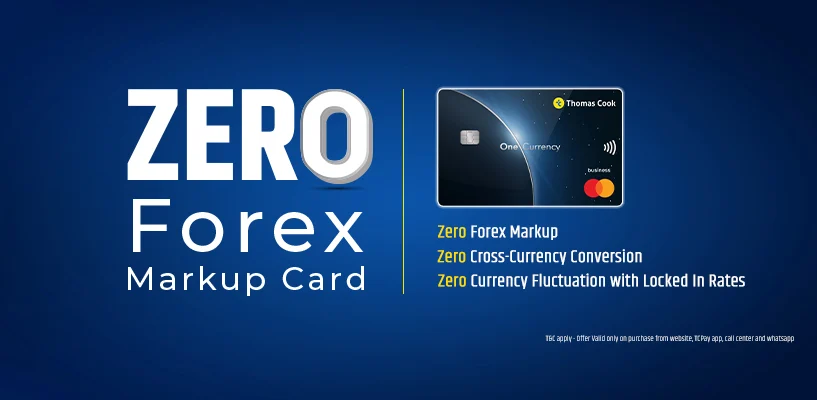

Table of contents
When you travel overseas, pay for online courses in dollars, or purchase on international websites, those little additional charges on your card can pile up over time. This is when a card with zero forex markup makes all the difference. You pay nearly exactly what the currency is worth on each overseas transaction rather than an additional 2 to 3.5 per cent.
Consider a zero forex card as a more prudent method of making international purchases. This is important right now because the rupee’s fluctuations make every percentage point significant, whether you’re a student paying tuition, a frequent traveller planning several trips this year, or someone subscribing to foreign tools.
A solid forex card saves you money without requiring any additional action, as it uses Visa or Mastercard exchange rates directly. Selecting the appropriate card might discreetly save you thousands of dollars if you’re organising a trip or even making frequent overseas purchases.
What Is a Zero Forex Markup Card?
Simply put, a zero forex markup card allows you to make purchases in foreign currencies without the additional cost that banks typically impose on top of the conversion rate. The bank often adds a 2 to 3.5 per cent markup and translates the amount to Indian rupees when you swipe a standard forex card overseas or make an international payment. Most consumers are unaware of this hidden expense until they look at their statement.
In real life, it functions as follows:
- You can spend money in euros, dollars, or any other currency.
- The payment network uses its daily rate to convert it to Indian rupees.
- The bank does not apply its own markup cost while using a zero forex card.
Therefore, “zero” does not imply unrestricted currency conversion. It implies that the bank will not impose any additional fees. The network charge, which varies slightly every day, is still what you pay.
If you pay for international subscriptions, travel frequently, or study overseas, this is the ideal option for you. You can also use options like Thomas Cook Forex Cards to lock currency rates before travelling overseas if you prefer prepaid spending over credit-based payments.
One minor piece of advice: at checkout, always opt to pay in the local currency rather than Indian rupees. Many people lose money there without realising it.
Why Zero Forex Markup Matters (Cost Breakdown Section)
The largest expense isn’t always clear when you’re travelling or even making a reservation in dollars. It’s the additional percentage that your bank discreetly adds. This is precisely the point at which a card with no foreign exchange markup begins to have a significant impact.
Let’s dissect it so that it truly aids in your planning:
- Example 1: What you spent on holidays
- Let’s say you travel for 1,000,000 rupees.
- A typical card adds about 3.5% markup, or 3,500 rupees.
- GST (18%) increases that amount by almost 630 rupees.
- Extra total = 4,130 rupees
That additional fee is practically nonexistent when using a zero forex card. You can spend that money on a different activity, dinner, or hotel upgrade.
- Example 2: Online shopping or subscriptions
- Spending 10,000 rupees a year on foreign equipment or classes
- The additional cost for a regular card is between ₹350 and ₹400.
- This silently adds up over time.
- With a zero forex card
- Forex markup = 0
- GST on markup = 0
- You save the full 4,130 rupees
Now consider more than just one trip. These savings keep recurring silently if you travel twice a year, pay for classes, subscriptions, or make overseas purchases.
Another little yet crucial factor that most people overlook is:
Even incentives are insufficient when using a standard card. The 3%+ fee means that even with a 1% cashback, you are still paying extra. Any incentives you receive on a card with no currency markup remain significant.
Additionally, whenever you have the opportunity, always elect to pay in local currency. Due to low conversion rates, paying with Indian rupees overseas frequently results in an additional hidden 3 to 7%. This isn’t a luxury feature if you expect to travel abroad frequently or are planning a vacation soon. It’s among the simplest methods to reduce needless expenses.
Zero Forex Card vs Regular Card
The main way that a 0% forex markup card differs from a standard one is when you make foreign currency purchases overseas or online. To assist you in making a decision, consider this simple side-by-side:
| Feature | Zero Forex Markup Card | Regular Card |
| Forex charges | With a 0 forex markup card, you pay nearly the actual exchange rate because there is no additional percentage added to foreign transactions. | A standard forex card often has a markup of 1% to 3.5%, which subtly raises your overall expenses. |
| Rewards value | Since there is no cost associated with rewards and rebates, they truly feel beneficial. | Foreign exchange fees can cancel out rewards, particularly when it comes to travel expenses. |
| Overall cost abroad | Your spending remains consistent and modest because you simply pay the network charge. | You pay markup and GST in addition to the exchange rate, which can quickly mount up on larger purchases. |
| Best use case | Perfect whether you study abroad, travel, or shop abroad, even a few times a year. | better suited for regular use and domestic expenditure in India. |
| Annual fees | Certain cards, particularly premium ones with travel benefits, could have additional fees. | Many standard cards are inexpensive or free for life, but they are less effective overseas. |
| Spending control tip | It functions best when you monitor exchange rates and make all of your payments in local currency. | frequently results in increased expenses if you make careless currency conversion decisions. |
Zero Forex Card vs Forex Card vs Debit Card
These three options seem identical when you’re travelling overseas, but once you start spending money, they function rather differently. Here’s an easy-to-understand, practical comparison so you know what to utilise.
| Zero Forex Markup Card | Forex Card (Prepaid) | Debit Card |
| You can spend on credit and pay later with a zero forex markup card, which is useful for deposits or hotels. | Since a zero forex card is prepaid, you load funds ahead of time and only use that sum. | With a debit card, funds are taken straight out of your bank account. |
| uses real-time Visa or Mastercard rates, which are subject to daily fluctuations. | helpful if rates increase later because it locks the rate when you load money. | You end up spending more since it uses live rates but adds additional costs. |
| With a 0 forex markup card, you pay close to the actual exchange rate by avoiding the additional fee. | Typically, there is little to no markup, particularly on high-quality cards, but there can be loading or reload costs. | It is the most expensive choice, typically charging a markup of 2 to 3.5 per cent + GST. |
| High fees and interest from the start make it unsuitable. | For ATM withdrawals overseas, it is typically more affordable and useful. | It’s feasible, but costs can be expensive and erratic. |
| Perfect for earning rewards while swiping at hotels, airlines, and other purchases. | Ideal for budgeting and daily expenditures, particularly for students or extended travels. | Serves as a fallback in case other cards don’t work. |
RBI Guidelines, LRS & TCS Explained
Knowing RBI regulations will help you avoid unpleasant surprises when you plan to spend money abroad. These guidelines hold whether you use a zero forex markup card, or any other type of forex card.
- Liberalised Remittance Scheme (LRS)
- Without specific authorisation, you can send or spend up to USD 250,000 every fiscal year (April to March).
- Travel, schooling, medical costs, shopping, and even loading a foreign exchange card fall under this category.
- This limit is increased by each foreign swipe, foreign card load, and international transfer.
- TCS (Tax Collected at Source)
The majority of individuals get confused at this point.
- For the majority of international expenditures, there is no TCS up to ₹10 lakh annually.
- Beyond that:
- 2% TCS on everyday expenses like shopping and travel
- 5% TCS if you reserve a travel package abroad
- 0% TCS if a loan is used to pay for education
Crucial details: TCS is not an additional expense. When you file your income tax return, you can claim it back.
- What this means for you in real life
- While using a card with no FOREX markup reduces costs, it does not prevent TCS.
- If you study abroad or travel frequently, keep a rough record of your annual foreign expenses.
- LRS counts the loading of currency cards as well.
A little piece of advice: if you’re nearing 10 lakh, strategically schedule large payments across several fiscal years to prevent needless cash flow obstruction.
Hidden Charges to Watch Out For
Although it’s not totally “free,” a card with no currency markup can save you a lot of money. If you’re not diligent, a few minor charges may still appear. In reality, you should keep an eye out for the following:
- Dynamic Currency Conversion (DCC)
The machine could ask if you want to pay in Indian rupees when you’re overseas. Although it seems practical, it is a trap. A bad rate could cost you three to seven per cent. To truly profit from your card with no foreign exchange markup, always select the local currency.
- Interest if you don’t make a full payment
Interest rates can be extremely expensive if you carry over your bill. That might wipe out all of your foreign savings.
- Card withdrawals from ATMs
Many people overpay without realising it in this situation. From the start, you will be charged a fixed price plus interest. Cash withdrawals are not intended for even the greatest forex card.
- Conditional or annual fees
Certain cards aren’t really free. To avoid annual fees, you might have to fulfil expenditure requirements.
- Disparity in network exchange rates
You pay the Visa or Mastercard rate, which could be marginally higher than the live market rate, even if you have a zero forex card.
Who Should & Should Not Get a Zero Forex Card
A card with no foreign exchange markup is not necessary for everyone. It depends on how much you really spend when travelling elsewhere. Here’s an easy method to determine your fit.
- You SHOULD consider it if:
- You want to avoid paying extra for each swipe when you travel overseas, even once or twice a year.
- You are a student who must pay fees, rent, or other everyday costs in a different currency.
- You pay for subscriptions in dollars or shop online at international websites.
- Convenience is what you want, and a single forex card can easily handle large payments, travel, and lodging.
- You want savings in addition to incentives or lounge access.
In these situations, a card with no foreign exchange markup discreetly lowers expenses without altering your spending patterns.
- You may NOT need it if:
- The majority of your expenses are already covered in Indian rupees, and you hardly ever travel overseas.
- When travelling, you prefer to closely manage your spending using cash.
- You don’t want to handle credit bills or take a chance on interest.
- Instead of having to deal with daily swings, you would want to lock exchange rates in advance.
Here’s the honest takeaway:
If your objectives include regulated spending, fixed exchange rates, and budgeting, a zero forex card (prepaid forex card) would be more appropriate for you.
A straightforward mixture works best if you’re unsure. Use a currency card for regular travel spending and a card for reservations.
FAQs
- Are zero forex cards really zero?
The 2 to 3.5 per cent bank fee is eliminated with a zero FOREX markup card, but other expenses remain. The Visa or Mastercard rate is still what you pay, plus occasionally a tiny margin. Thus, “zero” refers to no markup rather than total freedom.
- Is GST applicable?
Yes, but only in terms of fees. There is no GST on a 0 forex markup card because it has no markup. Nonetheless, annual fees, cash withdrawals, and any additional expenses are still subject to GST.
- Is it better than a forex card?
Your style will determine this. For rewards and flexibility, a forex card is preferable. If you want rigorous budgeting and stable rates, especially for longer journeys, a prepaid zero forex card is preferable.
- Does TCS apply?
Yes, in accordance with LRS regulations. TCS is applicable if your annual international expenditure exceeds ₹10 lakh. Whether you use a card or a foreign exchange card is irrelevant. It is refundable when you file your taxes.
- Can I use it on Amazon US?
Yes, and it’s a great way to shop abroad. You can avoid additional fees on such payments by using a zero forex markup card. Just make sure that when you check out, you pay in USD rather than INR.
- What happens if I choose “Pay in INR”?
You’ll probably have to pay more. The merchant sets a lower rate in what is known as dynamic currency conversion. Always select the local currency to save money, even if your card has no foreign exchange markup.
- Does RBI regulate forex markup?
Not directly. Banks choose the markup, but the RBI uses LRS to regulate total foreign spending. Because of this, many cards have varying foreign exchange fees, including choices with no markup.
- Can NRIs apply?
For normal Indian cards, the answer is usually no. Residents with Indian income and PAN are the target audience for the majority of forex card alternatives. Specialised cards connected to NRE or NRO accounts are usually required for NRIs.

Table of contents
Our Forex Offerings
Delhi to Kedarnath distance: Best Route, Train Timings & Travel Guide

Jodhpur to Udaipur journey is an ultimate Rajasthan travel journey.

Everything You Need to Know About Mumbai to Goa Distance
Varanasi to Haridwar distance: Best Route, Train Timings & Travel Guide

Recommended Articles for you

What is the average cost of living in Singapore in 2026?
0 0 The Cost of Living in Singapore At A Glance Average monthly budget: A single person may need S$1505 every month excluding accommodation. The rest of the budget depends on lifestyle and location. Biggest expense: Accommodation is the largest […]
Top Universities in Germany for International Students
0 0 Germany universities for international students have been one of the most preferred destinations for many years. Public universities charge little to no tuition fees, offering excellent opportunities for globally valued research and English-taught programs across engineering, business, and […]
RBI Forex Guidelines for Foreign Exchange Transactions in India
0 0 What Do RBI Forex Guidelines Say? FEMA oversees the legal mechanism governing foreign exchange transactions in India. All Indian residents should deal in forex only through RBI-authorised persons and for permitted purposes. Under the Liberalised Remittance Scheme (LRS), […]
Cost of Living Index by Country: Compare Living Expenses Around the World (2026 Guide)
0 0 No two countries charge the same price for everyday life. A coffee that costs $2 in Hanoi can cost $7 in Zurich, and a one-bedroom apartment renting for $300 in Cairo might command $3,000 in Manhattan. These gaps […]
Delhi To Haridwar distance: Best Route, Train Timings & Travel Guide
0 0 Delhi to Haridwar At A Glance Haridwar is an integral religious destination for Hindus. In 2025, 3.4 crore people visited Haridwar, and that number is only expected to be higher at the end of 2026. If you are […]
Delhi to Kedarnath distance: Best Route, Train Timings & Travel Guide
0 0 Delhi to Kedarnath cannot be called a road trip, but it is a journey where the destination is sacred, so every part of the journey becomes a kind of storytelling. Most of the people ask, “Delhi to Kedarnath […]
Jodhpur to Udaipur journey is an ultimate Rajasthan travel journey.
0 0 These two destinations have completely different personalities, but the journey between the two destinations is mesmerising. Imagine yourself waking up to the blue-painted buildings of Jodhpur, covered with mighty forts and surrounded by beautiful desert vibes. And then […]
Kullu to Manali distance: Best Route, Train Timings & Road Trip Guide
0 0 Kullu to Manali At a Glance Kullu and Manali sit in the same valley, so this isn’t really a “journey” in the way Delhi to Manali is; it’s more of a short hop most travellers do on their […]
Everything You Need to Know About Mumbai to Goa Distance
0 0 Mumbai to Goa At a Glance Goa is one of the most happening places in India. It offers nature, partying, waterfalls, trails, water activities, and whatnot. Goa sees millions of tourists every year from all across the globe, […]
Varanasi to Haridwar distance: Best Route, Train Timings & Travel Guide
0 0 Varanasi to Haridwar at a Glance Here are the numbers, before anything else. People do this route mostly for one reason: both cities run a daily Ganga aarti, and pilgrims like pairing them into one circuit. Road: roughly […]
World’s Largest Waterfall: Experience the Majestic Beauty of Angel Falls Like Never Before
0 0 Angel Falls in Venezuela is the highest waterfall in the world. It is 979 metres high. The falls are in a large forest area called Canaima National Park. Getting there takes time, but the views are amazing. You […]
Visit the Largest Mall in the World: Everything You Need for the Perfect Shopping Trip
0 0 Largest Mall In The World At A Glance Iran Mall in Tehran, Iran, is the world’s biggest mall by total reported area. The mall is approximately 1.95 million square metres, or 21 million square feet. Note: The discussion […]
Top 10 Highest Railway Bridges in the World: Discover the Tallest Train Bridges and Their Incredible Stories
0 0 The world’s highest railway bridges are mostly in China and India. India’s Chenab Bridge is the tallest railway arch bridge at 359 metres, which is even higher than the Eiffel Tower. China’s Najiehe Bridge, at 310 metres, still […]
The Longest Beach in the World – All You Need to Know
0 0 Praia do Cassino in Brazil is about 254 km long, making it the longest continuous beach in the world. Cox’s Bazar in Bangladesh is also very well known and is called the longest natural sandy sea beach. So, […]
Ride the World’s Longest Cable Car to Hon Thom Island: Your Complete Phu Quoc Travel Guide
0 0 The Hon Thom cable car in Phu Quoc is renowned for its Guinness World Record as the longest sea-crossing cable car. Offering a great view of the Gulf of Thailand, this cable car ride stretches across 7.9 km. […]
Longest Bridge in the World: Where Record-Breaking Engineering Meets Stunning Landscapes
0 0 Ask most people to name the world’s longest bridge, and you’re likely to get a confident answer like the Golden Gate Bridge or the Brooklyn Bridge or some other famous landmark plastered across postcards and movies. But the […]
Largest Desert in the World: The Surprising Science Behind Antarctica’s Record-Breaking Landscape
0 0 A Glimpse of the Largest Desert in the World If you think a desert is defined by the presence of sand or high temperature, you are wrong. It is actually defined by very low precipitation. So, by this […]
Explore the Tallest Building in the World: Everything You Need to Know About Burj Khalifa
0 0 The tallest building in the world, Burj Khalifa, is an epitome of architectural and engineering marvel. Located in the new Downtown Dubai, Burj Khalifa is a super-tall skyscraper. Being the most tall building in the world, the structure […]
Explore the Highest Mountain in the World: A Complete Guide to Mount Everest and the Himalayas
0 0 A Glance At Complete Guide to Mount Everest and the Himalayas Mount Everest is the highest mountain above sea level. It stands at 8,849 metres, or Mount Everest height in feet is 29,032 feet. It was Nepal and […]
Omkareshwar Jyotirlinga: Mandhata’s Om-Shaped Island, Mamleshwar Temple & Complete 2026 Travel Guide
0 0 Omkareshwar: Where the Narmada River Forms the Sacred ‘Om’ Omkareshwar lies on the banks of the Narmada, about 77 km from Indore. The river divides around Mandhata, also called Shivpuri, creating an island roughly 4 km long and […]