







My Bookings
View and manage bookings
{{totalPackagesHeader}} {{destination}} Holiday packages
Sort by
- Price Low to High
- Price High to Low
- Duration Low to High
- Duration High to Low
Filters
Applied filters
- {{appliedFilter.filter}}
-
{{filterData.flightDetails.withFlightCount}}
-
{{filterData.flightDetails.withoutFlightCount}}
{{ yearBlock.year }}
{{ mindurationDays - 1 }}N
{{ maxdurationDays - 1 }}N
-
{{filterData.duration.slot1.count}}
-
{{filterData.duration.slot2.count}}
-
{{filterData.duration.slot3.count}}
Price Range
₹ {{ formatPrice(minBudgetFilterValue) }}
₹ {{ formatPrice(maxBudgetFilterValue) }}
-
{{filterData.budget.slot1.count}}
-
{{filterData.budget.slot2.count}}
-
{{filterData.budget.slot3.count}}
-
{{filterData.tourType.standardCount}}
-
{{filterData.tourType.valueCount}}
-
{{filterData.tourType.premiumCount}}
Most Booked
Recommended
Honeymoon Special
Online Exclusive
Deal Available
Xmas & New Year Departures
Diwali Special
Durga Puja Special
Long Weekend Special
Trending Now
Luxury Escape
Budget Friendly
Last Minute Deal
Festive Special
Responsible Holiday
Villa Special
Split Stay
Buy 1 Get 1 Free
Limited Period Offer
Janmashtami Special
Cruise Stay Free
Van Tours
Holiday Pe Holiday Free
Diwali & Xmas Special
Xmas Special
{{ pkgData.packageDetail.duration - 1 }}N/{{
pkgData.packageDetail.duration }}D
Customized
Tour
Group
Tour
{{ getTourType(tourTypeFilterValue.length > 0 ?
parseInt(tourTypeFilterValue[tourTypeFilterValue.length - 1]) :
pkgData.minimumPricePackageClassId) }}
{{pkgData.packageDetail.pkgName}}
{{ timeline.noOfNights }}N {{ timeline.cityCode.cityName }}
+0
{{ timeline.noOfNights }}N {{ timeline.cityCode.cityName }}
Optional
Flights
Hotels
Sightseeing
Visa
Meal
Tour Manager
{{
formatPrice(getStrikeoutPrice(pkgData)) }}
{{ getDiscount(pkgData) }}% OFF
{{ formatPrice(getCurrentPrice(pkgData)) }} Starting price per adult
Most Booked
Recommended
Honeymoon Special
Online Exclusive
Deal Available
Xmas & New Year Departures
Diwali Special
Durga Puja Special
Long Weekend Special
Trending Now
Luxury Escape
Budget Friendly
Last Minute Deal
Festive Special
Responsible Holiday
Villa Special
Split Stay
Buy 1 Get 1 Free
Limited Period Offer
Janmashtami Special
Cruise Stay Free
Van Tours
Holiday Pe Holiday Free
Diwali & Xmas Special
Xmas Special
{{ pkgData.packageDetail.duration - 1 }}N/{{
pkgData.packageDetail.duration }}D
Customized
Tour
Group
Tour
{{ getTourType(tourTypeFilterValue.length > 0 ?
parseInt(tourTypeFilterValue[tourTypeFilterValue.length - 1]) :
pkgData.minimumPricePackageClassId) }}
{{pkgData.packageDetail.pkgName}}
{{ timeline.noOfNights }}N {{ timeline.cityCode.cityName }}
+0
{{ timeline.noOfNights }}N {{ timeline.cityCode.cityName }}
Optional
Flights
Hotels
Sightseeing
Visa
Meal
Tour Manager
{{
formatPrice(getStrikeoutPrice(pkgData)) }}
{{ getDiscount(pkgData) }}% OFF
{{ formatPrice(getCurrentPrice(pkgData)) }} Starting price per adult
Let us Help you Decide
Plan your trip with travel experts for perfectly designed packages.
{{ nameError }}
{{ phoneNumberError }}
{{ emailError }}
Thank you for your interest in our holiday package.
Our expert will
contact you shortly.
Most Booked
Recommended
Honeymoon Special
Online Exclusive
Deal Available
Xmas & New Year Departures
Diwali Special
Durga Puja Special
Long Weekend Special
Trending Now
Luxury Escape
Budget Friendly
Last Minute Deal
Festive Special
Responsible Holiday
Villa Special
Split Stay
Buy 1 Get 1 Free
Limited Period Offer
Janmashtami Special
Cruise Stay Free
Van Tours
Holiday Pe Holiday Free
Diwali & Xmas Special
Xmas Special
{{ pkgData.packageDetail.duration - 1 }}N/{{
pkgData.packageDetail.duration }}D
Customized
Tour
Group
Tour
{{ getTourType(tourTypeFilterValue.length > 0 ?
parseInt(tourTypeFilterValue[tourTypeFilterValue.length - 1]) :
pkgData.minimumPricePackageClassId) }}
{{pkgData.packageDetail.pkgName}}
{{ timeline.noOfNights }}N {{ timeline.cityCode.cityName }}
+0
{{ timeline.noOfNights }}N {{ timeline.cityCode.cityName }}
Optional
Flights
Hotels
Sightseeing
Visa
Meal
Tour Manager
{{
formatPrice(getStrikeoutPrice(pkgData)) }}
{{ getDiscount(pkgData) }}% OFF
{{ formatPrice(getCurrentPrice(pkgData)) }} Starting price per adult
Most Booked
Recommended
Honeymoon Special
Online Exclusive
Deal Available
Xmas & New Year Departures
Diwali Special
Durga Puja Special
Long Weekend Special
Trending Now
Luxury Escape
Budget Friendly
Last Minute Deal
Festive Special
Responsible Holiday
Villa Special
Split Stay
Buy 1 Get 1 Free
Limited Period Offer
Janmashtami Special
Cruise Stay Free
Van Tours
Holiday Pe Holiday Free
Diwali & Xmas Special
Xmas Special
{{ pkgData.packageDetail.duration - 1 }}N/{{
pkgData.packageDetail.duration }}D
Customized
Tour
Group
Tour
{{ getTourType(tourTypeFilterValue.length > 0 ?
parseInt(tourTypeFilterValue[tourTypeFilterValue.length - 1]) :
pkgData.minimumPricePackageClassId) }}
{{pkgData.packageDetail.pkgName}}
{{ timeline.noOfNights }}N {{ timeline.cityCode.cityName }}
+0
{{ timeline.noOfNights }}N {{ timeline.cityCode.cityName }}
Optional
Flights
Hotels
Sightseeing
Visa
Meal
Tour Manager
{{
formatPrice(getStrikeoutPrice(pkgData)) }}
{{ getDiscount(pkgData) }}% OFF
{{ formatPrice(getCurrentPrice(pkgData)) }} Starting price per adult

Looks like we’re out of packages for your current selection
Try removing some filters to find your perfect getaway
Loading Packages ...
{{manager.tourManagerName}}
Experience
{{manager.experienceYears}}+ Years
Languages
{{manager.languageSpoken}}
Frequently Asked Questions
6 to 7 days does it. Covers Leh, Nubra, and Pangong without rushing, which is probably why that's the most-booked bracket across nearly every operator's Ladakh tour packages.
Heavy woollens for the nights, layers for daytime since the temperature swings a lot between sun and shade, a windproof jacket, and shoes you don't mind getting dusty.
Yes, and don't skip this bit. Every traveller, Indian or foreign, needs an Inner Line Permit for the protected zones, Pangong, Nubra, Tso Moriri, all of it. Most operators sort this for you before you land, but if you're going solo, factor in a morning at the DC office in Leh.
May or June, most years. September's a decent second choice if you'd rather avoid the crowds and don't mind slightly cooler evenings.
Thukpa, momos (locals call them mokmoks more often than not), and a bowl of Qahwa somewhere in the old town. Skip the hotel buffet at least once for this.
It's real. Leh sits above 11,000 feet, and the air genuinely feels thinner the second you step off the plane. Rest for a day, drink more water than feels necessary, skip the beer on night one. Most people are fine after that.
You can, but it's a completely different trip. Think Chadar Trek on the frozen river, not sightseeing drives to Pangong. Not for everyone.
Depends on the operator, honestly. A lot of them list it as optional, so the headline price looks lower. Worth actually reading the fine print before comparing one Leh Ladakh trip cost against another, because two "similar" quotes can mean very different things once flights get added back in.
Yes, genuinely. Safer than a lot of places, honestly. Joining a group tour just makes the logistics easier and gives you people to split a jeep with.
Not at all. Every hotel, homestay, and roadside diner has options; this part isn't a concern.
Yes, though it's worth a quick word with a pediatrician first given the altitude. And flying in tends to work better for younger kids than a long, bumpy road trip.
Most reputable ones do, Thomas Cook included, particularly on the higher-altitude legs. Worth confirming directly if it matters to you, since not every budget operator bothers.
Around ₹20,500 per person for the basic version. Goes up fast once you add hotel category, season, and whether you're flying in.
Only postpaid SIMs work at all in the region. And even then, once you're past Leh town, especially around Pangong, expect the signal to just vanish for stretches.
Yes, if it's a proper group departure with a support vehicle trailing behind and a lead rider who actually knows the route. Wouldn't recommend it solo though, not on those roads.
Ladakh must have been on your must-visit list for what feels like forever. If you had been waiting for a sign to finally plan Ladakh trip, imagine waking up to the Indus flowing quietly past your hotel, sipping coffee with the mountains around Khardung La in the backdrop, or driving towards Pangong Lake and watching that first streak of blue appear between the mountains.
That’s the Ladakh you’ve probably been picturing.
But what would your Ladakh trip package look like? Would you spend a week in Leh, Nubra, and Pangong? A night in the last northernmost village of Turtuk? A bike ride through the mountains? A slower Ladakh tour where you actually have time to sit at a café in Leh instead of ticking off another sightseeing stop?
Once you know that, choosing a Ladakh trip package becomes much simpler. So before you start comparing prices and itineraries, let’s figure out how many days you need, where you should go, when to travel and what to look for in your Ladakh tour package.
Table of Content
- Travelling Together? Check the Buy 1 Get 1 Offer
- TL;DR
- What's Waiting for You Here?
- Plan your Ladakh Tour with Thomas Cook
- Why Choose Thomas Cook for Your Leh Ladakh Trip?
- Planned itineraries for you
- Experienced drivers
- 150+ Years of expertise
- What is the Ladakh Trip Cost per Person?
- Budget trips
- Mid-range or standard packages
- Luxury trips or bike expeditions
- Fuel Costs and Transport Pricing
- Inclusions that you don’t see coming
- A Ideal Ladakh Trip Itinerary Worth Stealing
- Not Sure Which Part of Ladakh to Cover First?
- Leh City Hub
- Nubra Valley
- Pangong Tso
- Tso Moriri
- Sham Valley
- Turtuk and Kargil
- What types of Leh Ladakh Tour Packages can you expect?
- Bike Expedition Packages
- Family Packages
- Honeymoon Packages
- Trek and Adventurous Packages
- Group Packages
- How Long Should Your Ladakh Trip Really Be?
- Quick warning
- Ladakh 3 Nights 4 Days Tour Package
- Ladakh 4 Nights 5 Days Trip Package
- Ladakh 5 Nights 6 Days Tourism Package
- 6 Nights 7 Days Ladakh Packages
- 7 Nights 8 Days Leh Ladakh Package
- Ladakh 8 Nights 9 Days Trip Packages
- Ladakh 9 Nights 10 Days Vacation Package
- Ladakh 10 Days 11 Nights Tourism Package
- Ladakh 11 Nights 12 Days Tours
- Which Month Actually Works Best for You?
- Best Ladakh Tour Package in January
- Top Ladakh Trip Package in February
- Best Ladakh Tourism Package in March
- Best Ladakh Packages in April
- Most Popular Leh Ladakh Package in May
- Ladakh Trip Packages in June
- Ladakh Vacation Package in July
- Ladakh Tourism Package in August
- Popular Ladakh Tours in September
- Ladakh Tour Package in October
- Top Ladakh Travel Package in November
- Best Ladakh Family Package in December
- Skip the Flight or Take It? Here's the Real Trade-Off
- Flights
- Without Flights
- What Are the Must-See Spots?
- Khardung La
- Magnetic Hill
- Pangong Lake
- Thiksey Monastery
- Leh Palace
- Diskit Monastery
- Sangam Confluence
- Beyond Sightseeing
- River rafting
- Quad biking and camel rides
- Stargazing
- Try the local food
- Shop the main market
- When Is the Best Time to Actually Go?
- May-June
- July-August
- September
- October
- November-March
- How to Reach Ladakh?
- By Air
- By Road via Manali
- By Road via Srinagar
- What are Smart Tips that will actually guide you in Ladakh?
- The Acclimatisation
- Hydrate yourself
- Keep yourself warm
- Carry cash
- Network
- Facts About Ladakh Worth Knowing Before You Go
- All about Ladakh
- Ladakh Holiday Packages
- Famous Places to visit in Ladakh
Travelling Together? Check the Buy 1 Get 1 Offer.
Ladakh is one of those places where you’ll want someone beside you for the long drives, chai stops, first glimpse of Pangong, and all those “you have to see this” moments. If you’re planning to travel with a partner, friend or family member, check Thomas Cook’s Buy 1 Get 1 Free offer while comparing Ladakh packages. The offer is currently listed for Ladakh as well as other domestic holidays, but inclusions, eligibility, availability and validity can change. So, check the latest offer terms at the time of booking rather than planning your trip around an older deal.
TL;DR:
- Ideal trip length: Plan for 6–7 days for Leh, Nubra Valley and Pangong Lake, including time to acclimatise in Leh.
- Best time to go: May to September is the main season for a Ladakh trip, with most routes and attractions accessible.
- Getting there: Fly directly to Leh for the quickest option, take 2 days to acclimatise, or make the journey part of your holiday with a road trip via Manali or via Srinagar.
- What to budget for: The entire trip cost depends on the season, duration, hotel category, transport and inclusions, so compare packages beyond their starting price. Look for the best package deals.
- Before you book: Check the route, acclimatisation time, permits, stays, transfers and activities included in your Ladakh trip package, as these can make a big difference to the actual experience.
What's Waiting for You Here?
Ladakh sits at an average altitude of over 11,000 feet, tucked between the Karakoram and the Himalayas, and the terrain looks closer to Tibet or the Mongolian steppe than anything else in India. Locals in Leh still refer to the region as "moonland" in casual conversation, a nickname that started because a patch near Lamayuru genuinely looks lunar. Below is a quick snapshot before the detailed sections dig in.
|
Feature |
Details |
|
Ideal Duration |
6 to 10 days for most travellers |
|
Major Attractions |
Pangong Tso, Nubra Valley, Khardung La, Leh Palace, Thiksey Monastery |
|
Best Time to Visit |
May to September, when roads are open and the weather is suitable for travel |
|
Key Activities |
Monastery visits, camel rides on double-humped Bactrian camels, river rafting, biking |
|
Currency to Carry |
Cash, as ATMs become scarce outside Leh town |
|
Starting Base |
Leh, accessible by flight or via the Manali and Srinagar highways |
A trip to Ladakh isn't really one destination; it's four or five distinct micro-regions stitched together by long drives, and that's something a lot of first-timers underestimate when they're comparing Ladakh tourism packages online. Scroll through enough Leh Ladakh packages and a pattern emerges fast: the ones quoting suspiciously low prices tend to strip out the Pangong overnight or swap private cabs for shared ones without saying so upfront.
Plan your Ladakh Tour with Thomas Cook
Why Choose Thomas Cook for Your Leh Ladakh Trip?
Booking a self-planned trip sounds cheaper on paper until the permit office in Leh closes at 4 pm sharp, and there's still a stack of Inner Line Permits to sort out for Nubra and Pangong. That's usually the moment people wish they'd gone with an operator instead. Thomas Cook handles that entire mess before the traveller even lands.
Planned itineraries for you:
Every Ladakh tour package from Thomas Cook is built around one non-negotiable rule: acclimatisation first, sightseeing second. Itineraries are deliberately paced so nobody is rushed up to Khardung La on day one, which is exactly the kind of mistake that sends people to the Sonam Norboo Memorial Hospital in Leh with altitude sickness.
Experienced drivers:
Drivers on these routes are locals who've done the Chang La and Wari La climbs hundreds of times, not city drivers unfamiliar with black ice patches at 17,000 feet. One driver on the Chang La stretch pulled over mid-drive, no warning, just to point out a herd of blue sheep on the rock face above. Ten minutes lost. Worth every one of them.
150+ Years of expertise:
Thomas Cook's Ladakh trip package lineup was built after years of running trips through both the Manali and Srinagar corridors, which means the itineraries account for things a first-time planner simply wouldn't know to ask about. A few things that separate a Thomas Cook Leh Ladakh tour from a piecemeal DIY booking:
- Permits, local transit, and even medical oxygen cylinders are arranged in advance, so nobody's scrambling at a checkpoint in Karu.
- Guided support comes from tour managers who know which dhaba near Sarchu actually has clean washrooms and which one to skip.
- Budgets are flexible. Packages can be customised, which makes even a premium Ladakh tour package manageable without draining savings in one go.
None of that shows up in a plain itinerary PDF, but it's the difference between a trip that runs smoothly and one where three hours get lost arguing with a permit clerk in broken Ladakhi.
People searching specifically for the best Ladakh tour packages tend to compare five or six operators before booking, and rightly so given how much variance exists in vehicle quality alone. What usually tips the decision is less about price and more about whether the operator has actually run a Leh Ladakh tour through winter closures and knows how to reroute on short notice.
Thomas Cook's premium Ladakh tour package tier goes a step further, adding boutique camp stays at Pangong and Nubra instead of the standard tented setups, which matters a lot once the sun drops and the temperature follows it down.
What is the Ladakh Trip Cost per Person?
Everyone asks the same question first: what's the actual Ladakh trip cost per person going to look like?
The honest answer is that it swings wildly depending on season, hotel category, and whether flights are bundled in. A friend who went in peak July paid nearly double what another paid for a near-identical route booked in late September. Genuinely double. Same hotels, same route, just different weeks. Here are some package prices you can expect:
SRP_PACKAGES_TABLE
As a rough guide for a standard 6 nights, 7 days route (excluding the main flight into Leh):
Budget trips:
20,000 to 30,000 rupees per person, covering guesthouses, shared Tempo Traveller transport, and simple thali-style meals.
Mid-range or standard packages:
34,000 to 47,000 rupees per person, which is where something like the Magical Ladakh 6N/7D package sits, with 3-star hotels, private Innova or Scorpio transport, and buffet meals included.
Luxury trips or bike expeditions:
30,000 up to 60,000 rupees or more, especially for specialised routes like the Umling La circuit, which at over 19,000 feet is the highest motorable point in the world and needs a properly serviced bike, not a rental with worn brake pads.
Fuel Costs and Transport Pricing:
Fuel surcharges tend to spike costs on the Nubra and Pangong legs, since diesel in Leh runs noticeably higher than in the plains, and that gets baked into the final Ladakh trip budget whether it's itemised separately or not.
Inclusions that you don’t see coming:
Anyone comparing five different quotes for the same route should ask exactly what's excluded, because "package inclusions" can mean very different things between operators.
- Even the most carefully priced cheapest Ladakh tour package on the market still needs a buffer of two or three thousand rupees for things that never make it onto the printed itinerary: monastery donations, extra blankets at altitude, the odd bowl of Maggi at a roadside stall that costs triple what it would in Leh town.
- Working out the exact Leh Ladakh trip cost before booking also means asking about oxygen charges, camera fees at monasteries (usually 20 to 50 rupees each), and whether the permit cost is bundled in or billed separately.
A Ideal Ladakh Trip Itinerary Worth Stealing
Every Ladakh trip itinerary looks slightly different depending on operator and season, but a well-paced 7-day version tends to follow a rhythm that actually works with the altitude instead of against it. Here's roughly how it plays out on the ground.
(Quick aside: don't trust the "estimated drive time" on any printed itinerary. Google Maps says Leh to Pangong is 3 hours. It's not. Add at least ninety minutes for photo stops, a herd of yaks blocking the road near Chang La, and one mandatory tea break because your knees have gone numb from the cold.)
- Day one is arrival and nothing else, deliberately. Check in, drink water, nap if the body demands it, and maybe a slow evening walk to Leh Main Bazaar once the sun's lower and the air feels less thin.
- Day two stays local too: Leh Palace, Shanti Stupa, and the Hall of Fame, easy walking, no major altitude gain.
- By day three, the body's usually ready for Khardung La and the drop into Nubra Valley, with an overnight stay near Hunder so there's time for the camel rides and dunes without rushing back.
- Day four heads deeper into Nubra, maybe Diskit Monastery and a slower morning, before the long drive over to Pangong via Shyok, arriving in time to catch the lake changing colour as evening sets in.
- Day five is the Pangong morning, watching sunrise over the water before the return drive to Leh via Chang La.
- Day six covers Sham Valley, Magnetic Hill, Sangam, Alchi, all fairly relaxed with shorter driving stretches.
- Day seven is departure.
Anyone building their own Ladakh trip plan from scratch should keep that acclimatisation-first structure even if the destinations swap around. Skipping day one's rest to squeeze in extra sightseeing is the single most common mistake first-timers make, and it's the one that ruins the rest of the week for a surprising number of them.
A slightly longer Ladakh trip plan, spread across eight or nine days rather than seven, gives far more breathing room if weather closes a pass unexpectedly, which happens more often than most operators like to admit.
Not Sure Which Part of Ladakh to Cover First?
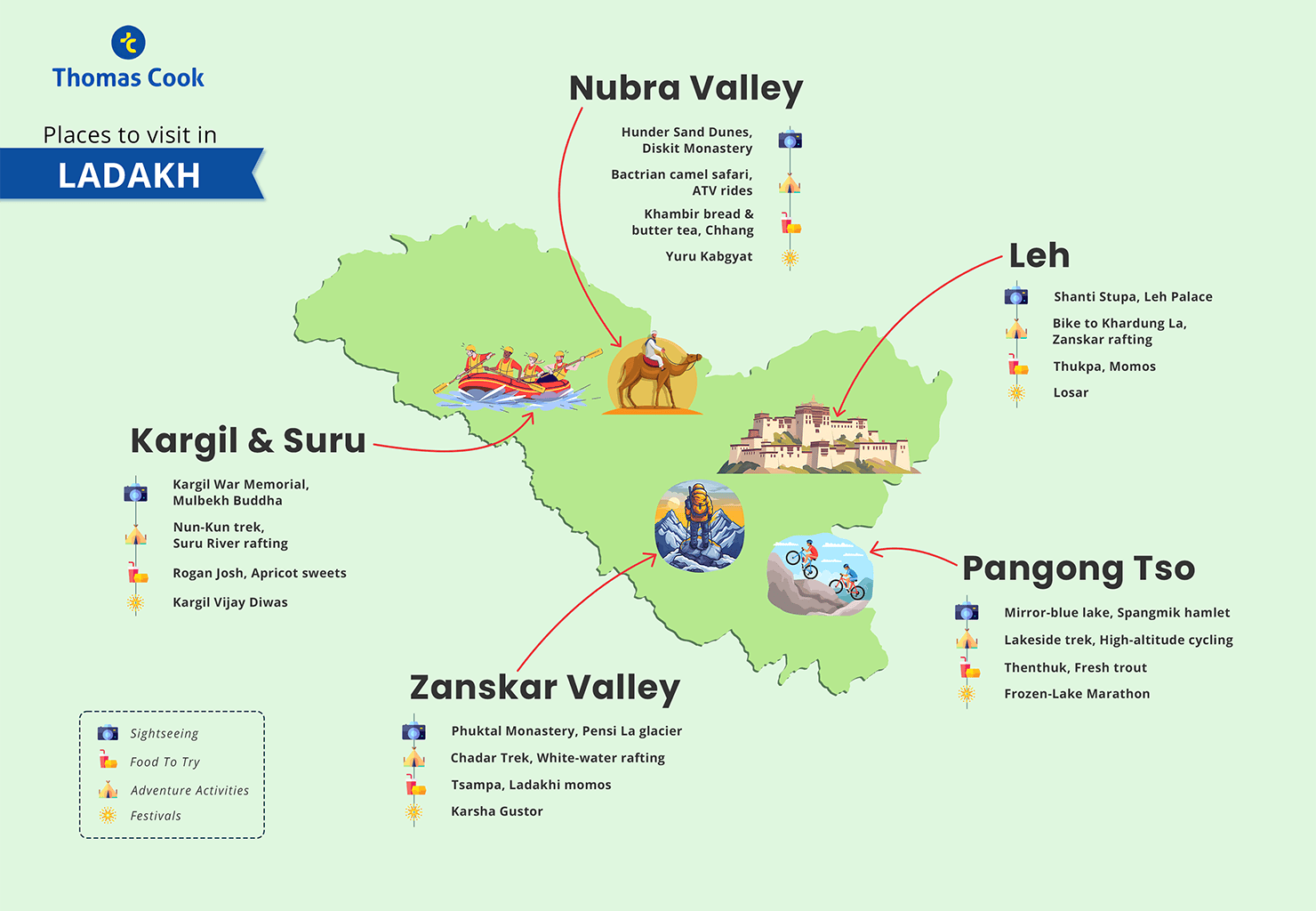
Ladakh isn't one place to tick off; it's a handful of very different landscapes strung along mountain roads. Splitting a booking by destination helps make sense of what's actually being paid for.
Leh City Hub:
This is where every trip starts and usually ends. Leh Palace looks worn and half-abandoned up close, nothing like the postcard version, but the view from its rooftop over the old town at dusk is worth the climb. Shanti Stupa, the Hall of Fame war memorial, and the chaotic little lanes of Leh Main Bazaar round out the local sightseeing.
Nubra Valley:
Crossing Khardung La to reach Nubra is half the experience. Once down in the valley, the cold desert sand dunes near Hunder are genuinely strange, camel rides on double-humped Bactrian camels cost around 200 to 300 rupees for a short loop, and Diskit Monastery's giant Maitreya Buddha statue looks over the whole valley from a hillside.
Pangong Tso:
The lake everyone's seen in photos changes colour through the day, turquoise at noon, almost navy by evening. Camping by the shore means proper cold at night even in July, so extra layers aren't optional in this specific Ladakh famous places. Yes, it's the same stretch of water from the closing scene of 3 Idiots, and yes, half the tourists there are trying to recreate that shot with a scooter that doesn't exist anymore. Don't bother asking the homestay owners about it; they're bored of the question.
Tso Moriri:
Quieter, less commercialised, and better for anyone who wants to actually spot wildlife rather than just take photos at a crowded viewpoint. Kiang, the Tibetan wild ass, wander close to the road in this stretch.
Sham Valley:
The easier, lower-altitude loop out of Leh, covering Magnetic Hill, the Sangam confluence point, and Alchi Monastery, which has some of the oldest wall paintings in Ladakh, older even than Thiksey's collection.
Turtuk and Kargil:
For those with extra days, Turtuk was part of Pakistan until 1971 and still has a distinctly different culture, apricot orchards, and Balti architecture that doesn't look like the rest of Ladakh at all. Very few standard Ladakh travel packages include this stretch, which is exactly why it still feels comparatively untouched.
Whichever combination gets picked, the point of splitting Ladakh travel packages by destination is simple: nobody needs to pay for a Tso Moriri detour if the interest is really just Leh, Nubra, and Pangong on a tighter schedule.
Most Ladakh holiday packages sold online bundle three or four of these regions together by default, so it's always worth asking whether a particular stop can be dropped to bring the price down, rather than assuming the fixed combination is the only option on offer.
The strongest Leh Ladakh packages tend to sequence these regions in a way that respects altitude gain too, easing from Leh into Nubra before tackling the higher Pangong stretch, rather than throwing the toughest drive at travellers on day two.
What types of Leh Ladakh Tour Packages can you expect?
Not every traveller wants the same thing out of a trip to Ladakh, and package types reflect that.
You’ll meet a couple on a bike trip, mid-fifties, first time on an Enfield in twenty years, absolutely loving it.
Also meet a guy the same week who'd never ridden anything bigger than a scooter, decided Ladakh was the place to start. He didn't make it past Sarchu. Bruised ribs, wounded pride, flown home early.
So yes, know your limits before signing up for any Ladakh trip package that promises the highest passes in the world.
Bike Expedition Packages:
Bike expeditions are the loudest, most photographed version, usually built around Royal Enfields with a backup support vehicle trailing behind for breakdowns, which happen more often than riders expect on the Pang to Sarchu stretch.
Family Packages:
Family Ladakh holiday packages go the opposite direction entirely, favouring SUVs, minimal walking, and hotels with proper heating over rougher camp stays.
Honeymoon Packages:
Ladakh Honeymoon packages lean into the lake-view camps at Pangong or Nubra, private bonfires, and slower pacing with fewer sightseeing stops crammed into a day.
Trek and Adventurous Packages:
Then there are the adventure and trek-heavy options, the Chadar Trek across the frozen Zanskar river being the most extreme of the lot, walked in temperatures that regularly drop below minus 20°C.
Group Packages:
And for solo travellers or smaller groups, fixed-departure group tours split costs and put people together with strangers who usually end up becoming trip friends by day three, mostly because there's not much else to do after dinner in a guesthouse with patchy electricity.
Choosing between these Ladakh bike packages, family-oriented trips, or trek-based options really comes down to fitness level and risk appetite more than budget.
- A 45-year-old with a bad knee has no business signing up for Chadar just because it photographs well on Instagram.
- Riders comparing Ladakh bike packages across operators should also check whether the backup vehicle actually carries spare parts or just a first-aid kit, because that distinction matters a lot somewhere between Pang and Sarchu.
A well-run Leh Ladakh tour, whichever style it follows, ultimately comes down to the same handful of fundamentals:
- A sensible pace
- A driver who knows the route in changing weather
- And an itinerary that doesn't pretend altitude sickness is someone else's problem.
Among the best Ladakh tour packages available today, the ones worth booking are usually the ones that spell out every inclusion clearly rather than leaving fuel, permits, or camera fees as vague footnotes.
How Long Should Your Ladakh Trip Really Be?
Time available usually decides the route more than anything else. Planning any trip to Ladakh starts with this question before anything else gets locked in. Here's roughly how each duration bracket breaks down, and picking the right Ladakh trip package length matters just as much as picking the right season.
Quick warning:
The 3N/4D one below sounds tempting on price. Skip it if you can. You’ll always hear the story of someone who did it once; they landed, saw Leh Palace, and basically flew back out still half-dazed from the altitude change.
Here’s a rundown of what you can actually expect from a trip to Ladakh:
Ladakh 3 Nights 4 Days Tour Package:
Barely enough for Leh city and one nearby excursion. Good only for people with genuinely no other option, and even then, expect to skip Nubra or Pangong entirely.
Ladakh 4 Nights 5 Days Trip Package:
Adds a single overnight push to either Nubra or Pangong, but not both. Rushed, and altitude acclimatisation gets compressed uncomfortably.
Ladakh 5 Nights 6 Days Tourism Package:
This is where a trip starts feeling complete. Leh, one night in Nubra, and a day trip toward Pangong (without the overnight stay) usually fits.
6 Nights 7 Days Ladakh Packages:
The most commonly booked bracket. Leh sightseeing, an overnight in Nubra, and an overnight at Pangong via Chang La, which is the pass most people remember for the sheer number of prayer flags strung across it.
7 Nights 8 Days Leh Ladakh Package:
Same core route as the 6N/7D, with a buffer day built in, usually for weather delays or a second attempt at Pangong if the first day's fog ruins the view.
Ladakh 8 Nights 9 Days Trip Packages:
Adds Sham Valley properly, including Alchi and the Sangam point, rather than squeezing it in as a rushed half-day.
Ladakh 9 Nights 10 Days vacation Package:
Room to include Tso Moriri, which most shorter trips skip entirely because of the extra driving distance involved.
Ladakh 10 Days 11 Nights Tourism Package:
A near-complete circuit: Leh, Nubra, Pangong, Tso Moriri, and a return route through Sham Valley, without feeling rushed at any single stop.
Ladakh 11 Nights 12 Days Tours:
The full loop, often including Turtuk and Kargil, built for travellers who genuinely want to see the whole region rather than the highlight reel.
Anyone deciding between these brackets should be realistic about how many hours of mountain driving they can actually tolerate per day, because the Ladakh trip itinerary on paper always looks shorter than it feels once you're on the actual road, bumping along at 20 km/h behind a BRO gravel truck.
Longer isn't automatically better either; some travellers find that a tightly built Ladakh trip package covering fewer places properly beats a sprawling twelve-day version that spends half its time driving rather than exploring.
Which Month Actually Works Best for You?
Season changes the entire character of a trip to Ladakh, not just the weather. Here's a rough month-by-month breakdown of how Ladakh tourism packages shift across the year, since the same route can feel like an entirely different holiday depending on when it's booked.
Best Ladakh Tour Package in January:
Deep winter. Roads to Nubra and Pangong are largely shut, but this is Chadar Trek season, walked on the frozen Zanskar River itself.
Top Ladakh trip package in February:
Similarly extreme cold, still trek-focused, with Leh town itself half-shuttered as many guesthouses close for winter.
Best Ladakh Tourism Package in March:
Transitional month, some snow still on the ground, most standard sightseeing routes remain closed until the highways clear properly.
Best Ladakh Packages in April:
The Srinagar-Leh highway typically opens around this point, though Manali-Leh stays shut, and this is really the earliest window for a standard trip.
Most Popular Leh Ladakh Package in May:
Considered the true start of the season. Snow walls still line some passes, weather is crisp, and both highways are usually open by mid-month.
Ladakh trip packages in June:
Peak comfort weather, warm days, cool nights, and every route fully accessible. Also the busiest month for bookings, so hotel availability tightens fast.
Ladakh vacation Package in July:
Warm, occasionally interrupted by monsoon-linked landslides on the lower Srinagar stretch, though Leh itself sits in a rain shadow and stays mostly dry.
Ladakh Tourism Package in August:
Local festivals pick up around this time, and it's peak family travel season since it overlaps school holidays.
Popular Ladakh Tours in September:
Arguably the best month for photography, golden light on the mountains, thinner crowds, and noticeably better hotel rates than July or August.
Ladakh Tour Package in October:
Cold nights start creeping in, and by late October, some higher routes begin closing, so this is the tail end of the standard season.
Top Ladakh travel Package in November:
Mostly closed to standard tourism, only Leh town itself remains reasonably accessible, and even that gets bitterly cold after sunset.
Best Ladakh family Package in December:
Peak winter cold sets in; generally not recommended for families with young children or elderly travellers, barring specialised winter photography trips.
Whatever month gets picked, it's worth cross-checking hotel availability directly, since some of the more popular Ladakh tourism packages sell out their fixed departures a good six to eight weeks ahead of June and July, leaving latecomers stuck with pricier, less convenient dates.
Skip the Flight or Take It? Here's the Real Trade-Off
This decision changes the whole shape of a trip, not just the transport.
Flights:
With flights means flying straight into Leh's Kushok Bakula Rimpochee Airport, which sits at over 10,000 feet, so the body has zero time to adjust gradually. Anyone on a Ladakh tour packages with Flights needs a genuine 36 to 48 hours of rest before doing anything strenuous, no exceptions, no matter how tempting it is to head straight out to Shanti Stupa on arrival evening.
Without Flights:
Without flights means a road trip in, usually via Manali or Srinagar, which sounds slower but actually helps the body acclimatise naturally across two or three days of gradual altitude gain.
The Manali route runs about 430 km, typically broken with an overnight halt in Jispa or Sarchu, crossing Rohtang, Baralacha La, and Tanglang La along the way.
The Srinagar route covers roughly 420 km through Sonmarg, Drass (one of the coldest inhabited places in India, officially recording close to -45°C some winters), and Kargil, and it's generally considered the gentler of the two ascents.
Neither is objectively better for how to reach Ladakh.
It's really a trade-off between time saved and how comfortably the body handles thin air, and that decision alone should shape which Leh Ladakh packages get shortlisted first. Travellers who genuinely enjoy long drives tend to prefer Ladakh trip packages without Flights for exactly that gradual-adjustment reason, while anyone tight on annual leave usually just books the flight and factors in the extra rest day.
What Are the Must-See Spots?
Some of these get overhyped online; others deserve every bit of the attention. Among the Ladakh famous places that actually live up to the hype, a handful stand out for reasons that have nothing to do with what the photos show. Quick rundown below, then a few notes worth reading properly.
Khardung La:
One of the world's highest motorable passes. The tea stall at the top does brisk Maggi and black coffee; there's genuinely nothing else to eat up there.
Magnetic Hill:
The optical illusion road where vehicles seem to roll uphill on their own. Ask the driver to try it twice; everyone does.
Pangong Lake:
Colour shifts from turquoise to deep navy through the day. Shoreline near Spangmik feels rawer, windier in person than any photo lets on.
Thiksey Monastery:
Twelve-storey complex often compared to Tibet's Potala Palace. The 6 am prayer session is worth the cold walk up, if a Ladakh travel guide can time it right.
Leh Palace:
Far more skeletal and bare inside than expected; most rooms are empty shells now. The rooftop view at dusk justifies the ticket regardless.
Diskit Monastery:
Nubra Valley's towering Maitreya Buddha statue, visible from almost anywhere in the lower valley.
Sangam Confluence:
Where the Indus and Zanskar rivers meet, two distinct water colours running side by side before merging.
Leh Palace, worth flagging separately: don't expect the grandeur the name suggests. It's more ruin than palace these days, half-restored, echoey, and honestly a bit sad in places. Still climb it though, that view over old Leh at dusk does something a lot of the bigger-ticket sights don't.
There are dozens of smaller places to visit in Leh Ladakh beyond this shortlist too, quiet villages, lesser-known gompas, roadside chortens, that rarely make it onto a standard itinerary but are worth asking a guide about if there's a free afternoon going spare.
Beyond Sightseeing, What Else Is There to Do?
Most lists of things to do in Ladakh repeat the same five activities without mentioning which ones actually need advance booking and which can be arranged on the spot. Most Ladakh tourism packages bundle two or three of these in as standard, worth checking which before assuming you'll need to pay extra on the ground. Here's the honest version of things to do in Ladakh:
River rafting:
Zanskar or Indus rivers. Phey to Nimmu stretch on the Indus is manageable for first-timers, books out fast in peak season.
Quad biking and camel rides:
Dunes near Hunder, Nubra Valley. Camel ride's about 200-300 rupees, quad biking runs closer to 500 rupees for a short circuit, more if you push the driver.
Stargazing:
Hanle, India's first Dark Sky Reserve. Milky Way visible with the naked eye, no gear needed. Genuinely rare to see skies like that anywhere else in the country.
Try the local food:
Butter tea (locals call it gur gur cha, not the polished "butter tea" on hotel menus), Qahwa, thukpa. A bowl near the Jama Masjid end of Leh Main Bazaar costs next to nothing.
Shop the main market:
Pashmina shawls, apricot jam, silver jewellery, prayer wheels. Bargain with the smaller family stalls, not the bigger tourist-facing shops near the taxi stand; they don't budge much.
When Is the Best Time to Actually Go?
Quick answer: mid-May to September, hands down, is the best time to visit Ladakh. Here's the breakdown by window:
May-June:
Crisp weather, snow walls still visible on some passes, roads freshly reopened. Ideal window for comfortable sightseeing.
July-August:
Warmest, occasional monsoon-linked disruption on the lower Srinagar route, though Leh itself sits in a rain shadow and stays largely dry.
September:
Golden light, thinner crowds, better hotel rates. Possibly the most underrated month on the calendar.
October:
Tail end of the season, cold nights, some higher routes start closing by late month.
November-March:
Genuinely extreme cold, well below -20°C in Leh and Kargil. Only for the Chadar Trek crowd, not standard sightseeing.
Daytime temperatures in the May-to-September window hover between 15°C and 25°C, and every hotel, homestay, and camp runs at full capacity. Pack for both extremes, not just one. Any Ladakh tour packages booked outside this window need a very different packing list and a very different mindset, honestly.
How to Reach Ladakh?
Working out how to reach Ladakh really comes down to three options. There's no single correct answer to how to go to Ladakh, only trade-offs between time, cost, and altitude.
By Air:
Kushok Bakula Rimpochee Airport in Leh runs daily connections from Delhi, and fairly regular ones from Mumbai and Chandigarh depending on season. This is the fastest option and the one most flight-based Leh Ladakh packages default to.
By Road via Manali:
A roughly 430 km stretch crossing several passes over 15,000 feet, usually broken with an overnight halt at Jispa or Sarchu since attempting it in one straight push is exhausting and honestly a bit dangerous given the altitude gain.
By Road via Srinagar:
Around 420 km through Sonmarg, Drass, and Kargil, a route that gains altitude far more gradually and tends to be gentler on the body, even if it takes a day longer overall.
Both road routes only open seasonally, generally from April or May through October, and both close abruptly at the first heavy snowfall, sometimes stranding late-season travellers for a night or two at a highway dhaba until the BRO clears the road.
What are Smart Tips that will actually guide you in Ladakh?
No Ladakh travel guide is complete without the boring, unglamorous stuff.
The Acclimatisation:
Acclimatisation isn't optional; it's the single biggest factor in whether a trip goes well or ends with someone vomiting into a bucket at 14,000 feet. Spend the first 36 to 48 hours resting properly in Leh before attempting anything higher.
Hydrate yourself:
Hydration matters more than most people expect; plain water, ORS, or the local salted butter tea all help.
Keep yourself warm:
Layering clothing is essential too, since the temperature swing between direct sun and shade can be brutal, easily 15 to 20 degrees apart within the same afternoon.
Carry cash:
Cash is king outside Leh town. ATMs vanish once past Karu, and digital payments are unreliable at best in Nubra or Pangong, so budgeting enough physical currency before leaving Leh saves a lot of stress later.
Network:
On connectivity, only postpaid SIMs work in the region; BSNL tends to have the widest, if patchiest, coverage in remote stretches, while Airtel and Jio perform better within Leh town itself.
Facts About Ladakh Worth Knowing Before You Go
A few facts about Ladakh rarely make it into standard itineraries, but they're worth knowing anyway.
- Despite the snow-capped peaks surrounding it, Ladakh is technically classified as a high-altitude cold desert, receiving barely any annual rainfall, which is part of why the landscape looks so stark and treeless in most directions.
- The Bailey Bridge between the Dras and Suru rivers, built by the Indian Army, holds the record as the highest bridge of its kind in the world.
- The region is also home to genuinely rare wildlife, the elusive snow leopard, the Tibetan wild ass known locally as kiang, and the black-necked crane, a bird considered sacred in local Buddhist tradition.
- At Sangam, that meeting point of the Indus and Zanskar rivers, the two distinctly coloured waters run side by side for a stretch before finally blending into one, one of the small facts about Ladakh that surprises most first-time visitors who expect an instant merge.




 {{loginErrorMsg}}